What Is a Cable Assembly? Types, Parts, and Manufacturing Process
In today's increasingly interconnected society, the smooth transmission of data, power, and a wide range of signals is critical. Cable assemblies play a vital role in fulfilling all these vital functions within such interconnected ecosystems.
Understanding the fundamentals of cable assembly design, manufacturing, and quality standards is very important for engineers, procurement personnel, and everyone involved in bringing new electronic products to market.
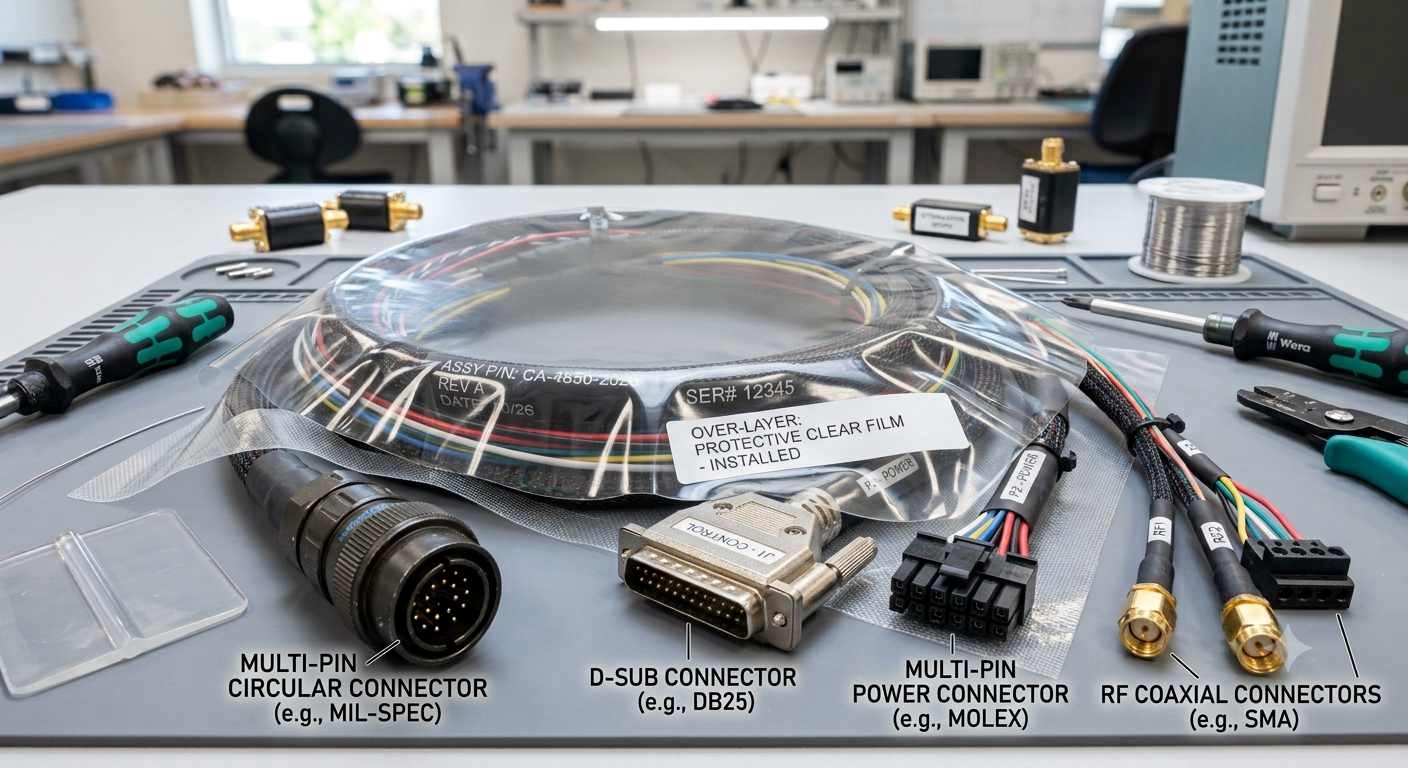
What Is a Cable Assembly?
A cable assembly is a group of wires, cables, or conductors that are terminated with connectors or other components to transmit power, data, or signals between electronic devices or systems. A cable assembly may include one or more cables or wires, along with connectors, shielding, protective sleeving, strain relief, or other components. Unlike individual wires or standard cables, a cable assembly is designed and constructed to meet specific electrical, mechanical, and environmental requirements.
These assemblies serve as the nervous system of electrical and electronic devices, ensuring efficient and reliable signal transmission. Key considerations in the design and manufacturing of a cable assembly include:
- Specific electrical performance requirements
- Local Restrictions
- Environmental factors (temperature, humidity, vibration, UV radiation)
- Compliance with industry standards and regulations
By combining multiple cables into a single unit, cable assemblies achieve improved structure, simplified installation, and enhanced system reliability.
Components of a Cable Assembly
Protection: Cable assemblies may use jackets, sleeves, heat-shrink tubing, conduit, or other protective materials to organize and protect wires and conductors from mechanical damage and Harsh weather or chemical conditions.
Environment: The construction and materials of a cable assembly are selected according to its operating environment, including temperature, moisture, chemicals, vibration, abrasion, and UV exposure.
Durability: Appropriate jackets, shielding, strain relief, and protective materials can improve resistance to moisture, abrasion, vibration, and electromagnetic interference (EMI), depending on the assembly design.
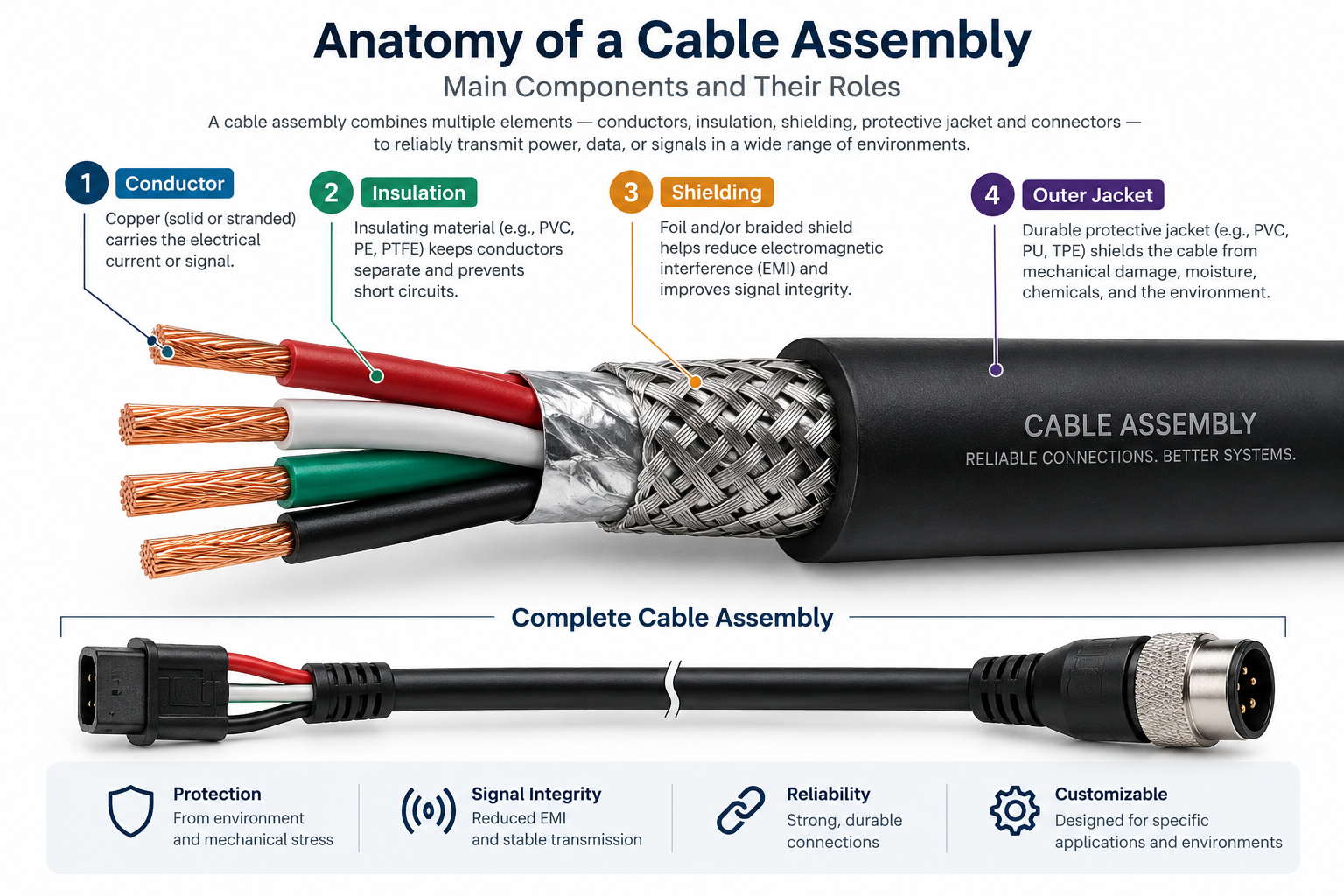
The robust cable assembly consists primarily of three main parts.
1. Conductors
These are the conductive elements that carry electrical current or signals. Copper is commonly used because of its high electrical conductivity, while stranded conductors are often selected when flexibility is required. Copper conductors may also be tin-plated to improve corrosion resistance and solderability in certain applications. Engineers select the appropriate AWG (American Wire Gauge) size based on current capacity, voltage drop, temperature, flexibility, and application requirements.
2. Insulation and Jacketing
The reliability of a cable depends upon the material selected for the insulation of a cable assembly.
- PVC (Polyvinyl Chloride): A versatile and cost-effective insulation and jacketing material commonly used in consumer electronics, appliances, control wiring, and general-purpose cable assemblies.
- PTFE (Polytetrafluoroethylene): A fluoropolymer known for excellent temperature resistance, chemical resistance, low friction, and stable electrical properties. It is commonly used for high-temperature, demanding electrical, and high-frequency applications.
- PUR (Polyurethane): Ideal for industrial automation applications requiring wear resistance and flexibility.
3. Connectors
Connectors provide the interface between a cable assembly and the equipment or another assembly. Common termination methods include crimping, soldering, and insulation displacement. Depending on the application, connectors may also include locking mechanisms, latches, or other retention features to help prevent unintended disconnection, particularly in applications exposed to vibration or movement.
Additional components may include shielding (for EMI/RFI protection), fillers, and protective over molding.
Types of Cable Assemblies
Cable assemblies come in various configurations, each engineered for specific operational environments and applications:
Coaxial Cable Assembly: This assembly consists of a coaxial cable terminated with suitable connectors. Its shielded construction helps control electromagnetic interference and supports reliable transmission of high-frequency signals. Coaxial cable assemblies are commonly used in broadcasting, wireless communications, test equipment, RF systems, and other high-frequency applications.
Ribbon Cable Assembly: Ribbon cable assemblies are compact, space-efficient, and allow for easy conductor identification. Applications include internal computer connections, printer mechanisms, and industrial control panels.
Fiber Optic: These cables are used for wide-bandwidth, long-distance data transmission, telecommunications, data centers, and high-speed networks.
USB: These cables are used for data transfer and device charging. Also used with consumer electronics and peripheral devices.
Ethernet Cables: These are used to connect network devices such as computers, switches, routers, and other equipment. Common twisted-pair Ethernet cable categories include Cat5e, Cat6, and Cat6A, with different categories supporting different performance levels and bandwidth requirements. Cat7 is also available in the market and is specified under ISO/IEC cabling standards.
Molded: These cables offer excellent durability and allow for visual customization. They are suitable for consumer electronics, automotive systems, medical equipment, and more.
RF/EMI: These cables offer excellent shielding performance and extremely low signal loss in high-frequency bands, making them suitable for applications such as mobile phone base stations, radar systems, and test equipment.
Other common types include D-Sub cables for RS-232 serial communication, HDMI cables for audio and video, and power cable assemblies for power transmission.
The Manufacturing Process
Manufacturing a custom cable assembly is a multistep process. The exact workflow varies according to the cable design, materials, connectors, production volume, and quality requirements. A typical process includes wire processing, termination, assembly, and final inspection and testing:
Step 1: Automated Wire Processing
The process begins with wire cutting, stripping, and marking. In mass production, these operations are usually performed by fully automated machines (such as systems from Komax or Schleuniger).
- Feeding: In this process, the wire is drawn from the master spool and fed into the drive rollers.
- Marking: Circuit IDs are printed onto the insulation of wires for quick and easy identification of different wires.
- Cutting: Wires are cut to the specified length according to the assembly drawing and applicable manufacturing tolerances.
- Stripping: Insulation is removed without damaging the copper strands.
Automated wire-processing machines can significantly increase production speed and consistency, although actual throughput depends on the machine, wire type, processing steps, and production requirements.
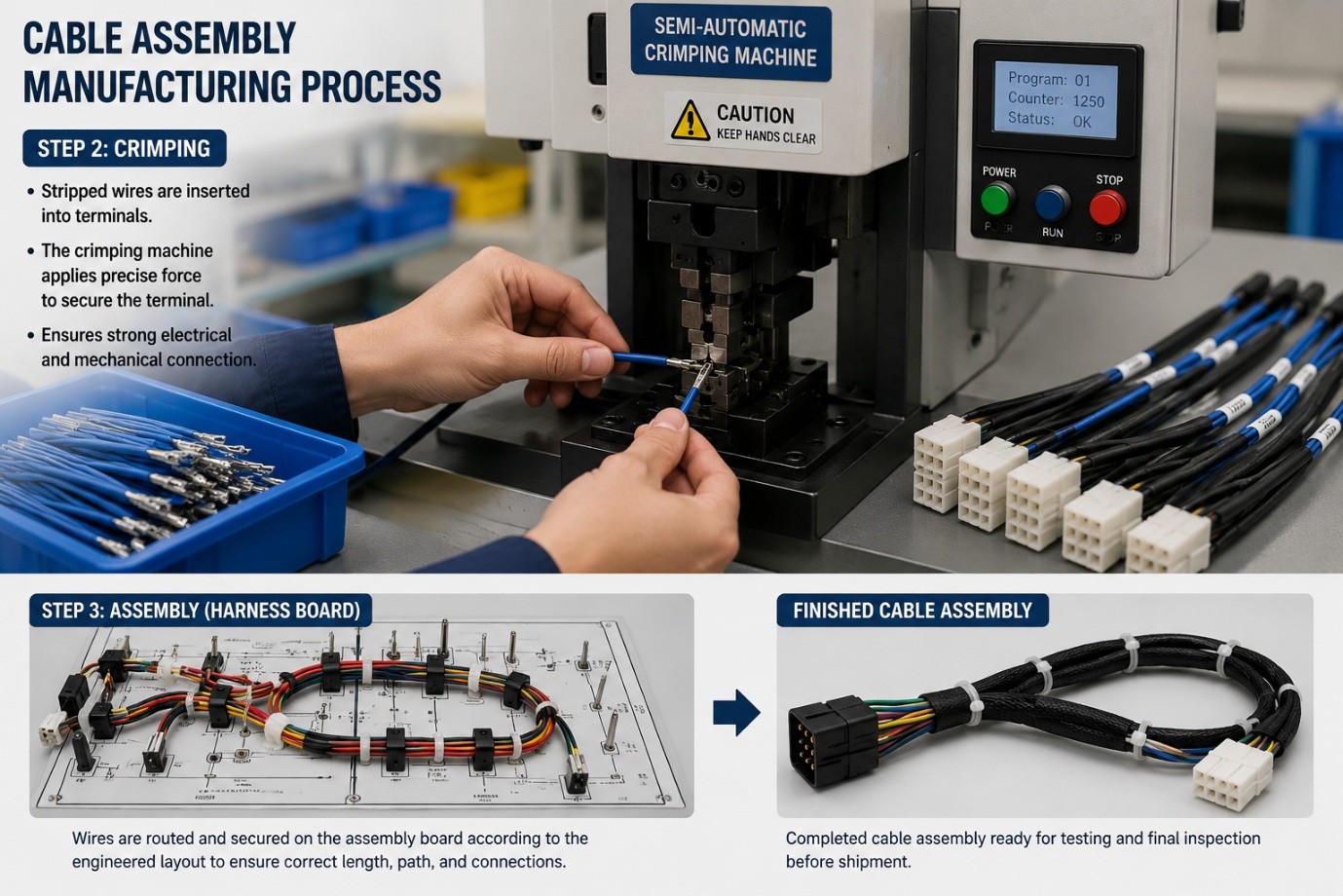
Step 2: Crimping
Stripped wires are connected to terminals via crimping, a process critical for ensuring electrical reliability. Depending on the terminal and wire size, semi-automatic crimping machines typically apply a force ranging from 1 to 5 tons. Before mass production begins, sample crimps undergo destructive tensile testing to verify connection strength and quality.
Step 3: Assembly
The wiring is routed and assembled according to the diagram on the harness board. This stage may include shrinking the tubing/sleeves, arranging identifiers, and attaching reference designators.
Step 4: Final Testing and QA
All completed cable assemblies undergo 100% electrical testing, often using automated systems like CIRRIS, to verify continuity, pinout correctness, and proper operation. This ensures every unit meets strict quality specifications before shipment.
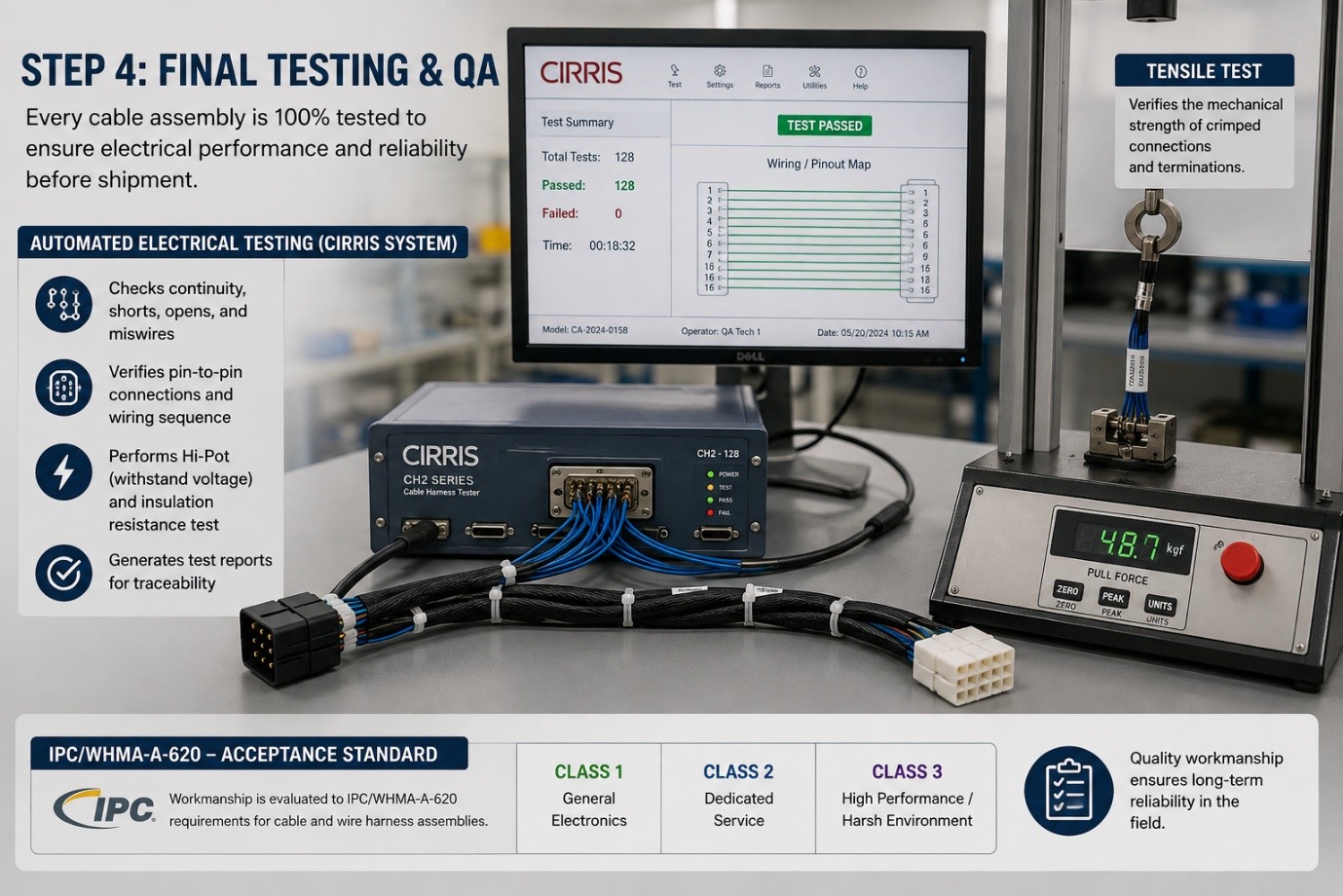
Testing Standards: IPC/WHMA-A-620
IPC/WHMA-A-620 is the premier industry-agreed standard for the requirements and acceptance of cable and wire harness assemblies. It defines global best practices, materials, preparation methods, testing protocols, and workmanship criteria.
This standard covers all processes, including preparation, molding, crimping, soldering, ultrasonic welding, joining, connector mounting, shielding, over molding, and marking.
Final products are classified into three acceptance levels:
- Class 1 – General Electronic Products: When the product's functionality is the primary requirement.
- Class 2 – Dedicated Service Electronic Products: Uninterrupted operation and a long lifespan are required. Uninterrupted service is desirable, but not essential.
- Class 3 – High Performance/Harsh Environment: Maintaining continuous performance is essential, and equipment downtime is unacceptable. The end-use environment may be extremely harsh (e.g., life-sustaining equipment or systems).
Key Applications across Industries
Cable assemblies play a crucial role in virtually every field of life.
Aerospace
Cable assemblies play a very important role in power transmission in aircraft engines, data transmission from satellites, and avionics systems. In this industry, precision and reliability are very important.
Automotive
In the automotive industry, cable assemblies are widely used in both gasoline-powered and electric vehicles. Electric vehicles require assemblies that are suitable for use in high-voltage power transmission with stringent thermal and safety standards.
Medical
Depending on the application, medical cable assemblies are engineered to withstand rigorous sterilization or harsh chemical disinfection. They are widely used in diagnostic imaging (such as MRI and X-ray systems), ultrasound equipment, electric beds, and dental chairs.
Telecommunications
Cable assemblies play a very important role in bundling and organizing dozens to thousands of cables within communication equipment.
Information Technology
From modems to routers, cable assemblies connect server racks, storage systems, and network infrastructure to maintain high-speed data flow in modern IT environments.
Industrial Automation
Cable assemblies are essential for supplying power to machinery, sensors, robots, and control systems.
Selection Guide
How do you pick the right cable assembly? Start by asking a few simple questions.
First, think about power and signal needs. How much current will the cable carry? Higher current needs thicker wires.
Next, look at the environment. Will the cable face heat, cold, or moisture? Outdoor cables need tougher jackets.
Check for movement too. Cables that bend a lot need flexible stranded wires. Stiff cables can crack over time.
Consider the connector type. Match connectors to your equipment's ports. Locking connectors help in high-vibration settings.
Don't forget industry standards. Aerospace and medical fields need strict certifications. Always confirm the required IPC/WHMA-A-620 class.
Finally, think about cost and lead time. Custom assemblies take longer to build. Standard designs are usually cheaper and faster.
Checking these points helps you pick the right cable assembly.
Emerging Trends
- Fiber Optic Integration: Advances in fiber optic technology are forcing design teams to rethink connector shapes and shielding methods.
- Miniaturization: There is a growing demand for smaller, lighter, and more efficient components.
- Hybrid Solutions: With the expansion of edge computing, there is a growing demand for assemblies that integrate power and data paths into a compact enclosure.
- Sustainability: Due to regulations and environmental considerations, there is a need to reconsider material substitutions and the selection of insulation materials.
- Supply Chain Resilience: Tariff measures are accelerating the diversification of sourcing from a single country.
Conclusion
At the end of the day, cable assemblies are much more than just bundled wires—they help keep critical systems running reliably across almost every industry. Whether you're setting up medical equipment, wiring an electric vehicle, or building data servers, getting the design right means matching the right materials, connectors, and protection to the application. Planning specifications early and following proven quality standards like IPC/WHMA-A-620 can help reduce the risk of costly failures and downtime.