A76 Equivalent: LR44, AG13, 357 and SR44 Guide
| Table of Contents |
What Is an A76 Battery and Its Equivalents?
The A76 is a common commercial designation for 1.5V alkaline button cells in the LR44 size format, though naming conventions may vary by brand and region.
It shares the same physical size as SR44/357-type cells, so it usually fits the same battery compartment; however, chemistry differences can affect runtime and voltage stability.
Core specifications for this battery size are generally consistent and include:
• Dimensions (typical): 11.6 mm diameter × 5.4 mm height (verify tolerances by datasheet).
• Nominal voltage: 1.5 V for alkaline, 1.55 V for silver oxide.
• Battery Chemistry (Chemical System): Primarily alkaline zinc manganese dioxide chemistry (Alkaline Manganese Dioxide) or silver oxide; the latter typically offers more stable voltage, longer lifespan, and dependable performance.
• Typical capacity range (varies by brand and discharge conditions): Alkaline 110-150 mAh; Silver oxide 150-200 mAh.(Measured under manufacturer-specified constant current discharge conditions; cutoff voltage and test current vary by chemistry and brand.)
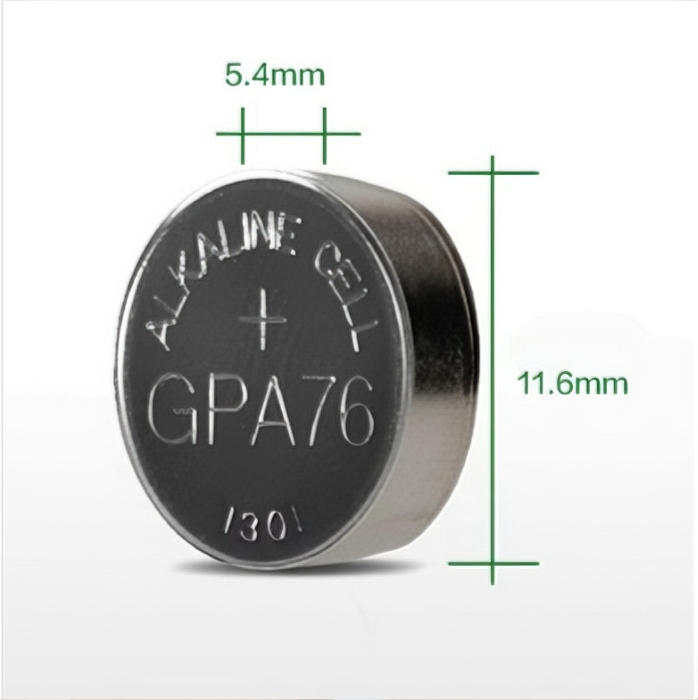
Therefore, when referring to an "A76 battery," it typically denotes alkaline models like LR44/AG13. When dimensionally compatible, it is also commonly substituted with silver oxide models such as SR44/357 (differing in chemical composition). To better understand the performance trade-offs between these two specific chemistries, our guide highlights the similarities and differences between LR44 and 357, offering a comprehensive technical comparison.
A76 vs LR44 vs AG13: Naming and Standards
|
Name |
Standard/Origin |
Typical Applications |
|
A76 |
Brand-specific commercial naming (e.g., Duracell) |
Retail packaging, targeting general consumers |
|
LR44 |
IEC (International Electrotechnical Commission) Standard Naming |
Technical documentation, engineering specifications |
|
AG13 |
Common generic/commercial names |
Universal Replacement, Parts Procurement |
Simply put, A76, LR44, and AG13 are often used interchangeably in retail and general replacement contexts because they share the same size; still, always verify the chemistry (alkaline vs silver oxide) for performance-critical devices. Thanks to their identical physical dimensions and similar nominal voltage, they are interchangeable in most low- to medium-power consumption devices. (e.g., toys, calculators, laser pointers).
A76 (LR44) Battery Specifications and Dimensions
A76/LR44 batteries adhere to precise specifications, understanding which is crucial for correct selection. Core specifications are detailed in the table below:
|
Parameter |
Specification Description |
|
Nominal Voltage |
Alkaline (LR44): 1.5 V; Silver Oxide (SR44): 1.55 V |
|
Common Capacity Range (varies by brand and discharge conditions) |
Alkaline: Approx. 110-150 mAh; Silver Oxide: Approx. 150-200 mAh |
|
Dimensions (Diameter x Height) |
11.6 mm (±0.2 mm) x 5.4 mm (±0.2 mm) |
|
Typical weight |
Approx. 2.0 - 2.3 grams (varies by brand) |
|
Equivalent sizes |
LR44 (alkaline), SR44 / 357 (silver oxide) |
|
The operating temperature range varies by manufacturer |
A common range is 0-60 °C, but always confirm with the specific datasheet. |
|
Shelf life depends on the manufacturer and storage conditions |
Many products are rated around 3 years (alkaline) or 5 years (silver oxide). |
Key Differences: Alkaline (LR44) vs Silver Oxide (SR44)
Although identical in size, the two chemical systems exhibit distinct performance characteristics:
• Discharge Curve (Voltage Stability): Silver oxide batteries maintain a very stable voltage (close to 1.55V) throughout their discharge curve until nearly depleted; alkaline batteries experience a gradual voltage decline during use.
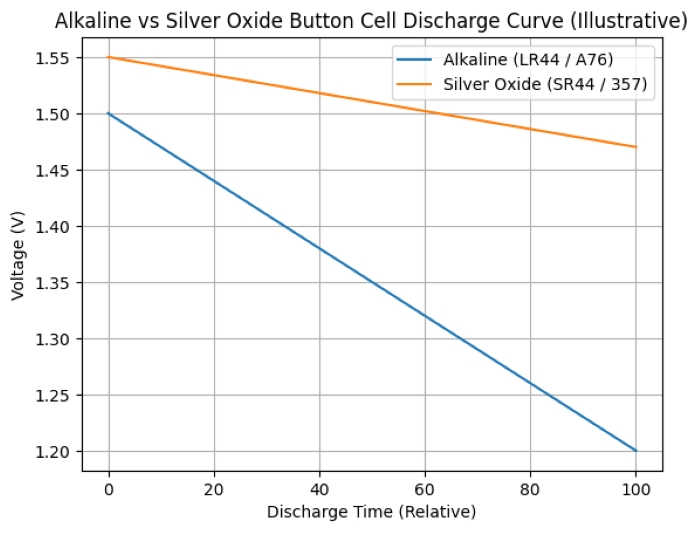
• Capacity and Lifespan: For the same size, silver oxide batteries typically offer higher actual capacity and longer service life, especially in voltage-sensitive devices.
• Leakage Risk: Alkaline batteries carry a relatively higher risk of electrolyte leakage after deep discharge or prolonged storage; Silver oxide batteries generally feature better sealing performance, which helps reduce the risk of leakage.
Core Engineering Selection Criteria: When selecting or replacing batteries for devices, prioritize the following key specifications: physical dimensions, chemical system (determining voltage and discharge characteristics), nominal voltage, and operating temperature range.
Thanks to their compact size, dependable performance, and role as reliable power sources, A76 Battery, LR44 Battery, and their equivalents are widely used in various small electronic devices.
|
Usage Scenarios |
Recommended Battery Type |
Recommended Reason |
|
Wrist Watches and Calculators |
Wrist Watches: Silver oxide batteries (SR44/357); Calculators: Alkaline batteries (LR44/A76) |
Wrist Watches require precise timekeeping; silver oxide batteries offer stable voltage, extended lifespan, and dependable performance. Calculators are cost-sensitive; alkaline batteries provide greater economic efficiency. |
|
Car Keys / Remote Controls and Toys |
Prefer Alkaline Batteries (LR44) |
Requires lower voltage stability, making alkaline batteries cost-effective; remove batteries when not in use for extended periods to prevent leakage damage |
|
Medical Devices (Digital Thermometers, Blood Glucose Monitors, etc.) |
Silver oxide batteries (SR44/357) |
Requires extremely high measurement accuracy and reliability; silver-oxide batteries offer stable voltage and low leakage risk |
|
Small instruments and laser pointers |
Small instruments: Silver oxide batteries (SR44/357); Laser pointers: LR44/SR44 (depending on design) |
Instruments require accurate readings, and silver oxide batteries provide a stable power source; laser pointers have broad compatibility, potentially using either battery type |
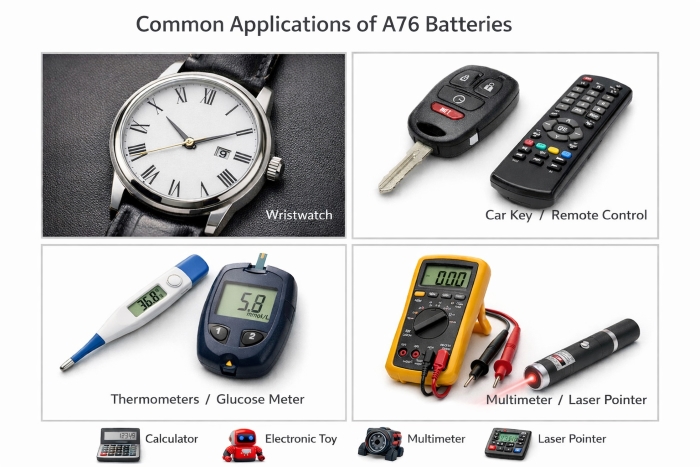
Ultimately, choosing between alkaline and silver oxide batteries depends on the device's requirements for voltage stability, lifespan, and leakage risk. Silver oxide batteries are typically the superior choice for applications demanding precision, reliability, or where the device holds higher value.
What Are the Equivalent Replacements for an A76 (LR44/AG13) Battery?
The A76, LR44, or AG13 battery belongs to an extensive button cell family with numerous A76 equivalent models. For a broader comparison of dimensions, refer to our guide on button cell sizes. The most common direct replacements include 357, SR44, LR1154, SR1154, G13, KA76, and others. These models share identical physical dimensions (approximately 11.6 mm diameter and 5.4 mm height), allowing them to fit into the same battery compartment.
However, please note: Physical size compatibility does not guarantee identical performance. Different names often correspond to different chemical systems (alkaline or silver oxide), which directly determine the battery's voltage, capacity, discharge characteristics, and lifespan. The following cross-reference list (table) clarifies this complex relationship between models, chemical systems, and performance:
|
Common Names (Market Terms) |
International Standard Naming (IEC / ANSI) |
Energizer PN |
Panasonic PN |
Chemical System |
Nominal Voltage |
Typical Capacity |
Key Features and Typical Applications |
|
A76 / AG13 |
LR44 |
A76 |
LR44 |
Alkaline |
1.5 V |
110–150 mAh |
Economical and versatile, suitable for toys, remote controls, calculators, and other devices with low voltage stability requirements |
|
LR1154 / V13GA |
LR44 |
A76 |
LR44 |
Alkaline |
1.5 V |
110–150 mAh |
Equivalent to LR44 in size and performance, commonly found in industrial or third-party brand names |
|
357 |
SR44 (ANSI: 357) |
357 |
SR44SW / SR44W |
Silver Oxide |
1.55 V |
150–200 mAh |
Highly stable voltage, long lifespan, low risk of leakage, suitable for watches, medical devices, and precision instruments |
|
SR1154 / V13GS |
SR44 |
357 |
SR44SW / SR44W |
Silver Oxide |
1.55 V |
150–200 mAh |
Silver oxide battery with specifications identical to 357; different name, but directly interchangeable |
|
G13 / KA76 / Vinnic L1154 / L1154 |
No standardized naming convention |
Depends on the specific model |
Depends on the specific model |
Depends on the brand |
1.5 V or 1.55 V |
Depends on the chemical system |
Most are generic packaging names (with Vinnic L1154 being a widely used branded variant); actual alkaline or silver oxide type requires checking the label. |
How to read this table?
1. Locate the target battery model via "Common Name (Market Name)" or "International Standard Name (IEC/ANSI)" (e.g., A76 corresponds to LR44, 357 corresponds to SR44)
2. Check the "Chemical System" to distinguish between alkaline (1.5 V, economical and versatile) and silver oxide (1.55 V, stable and long-lasting) types
3. Match device requirements using "Nominal Voltage, Typical Capacity" and "Key Features & Typical Applications." Note: Models under the same international standard (e.g., LR44/SR44) from different brands (Energizer/Panasonic) are directly interchangeable. For generic names lacking unified standards, verify the labeled chemical system.
Is LR44/A76 the Same as a 357 Battery?
|
Characteristics |
LR44 / A76 (Typical) |
357 (Typical) |
|
Chemical System |
Alkaline |
Silver Oxide |
|
Nominal Voltage |
1.5 V |
1.55 V |
|
Typical Capacity (Depends on Brand and Discharge Conditions) |
Lower (approx. 110-150 mAh) |
Higher (approx. 150-200 mAh) |
|
Voltage Stability |
Average (voltage gradually decreases during discharge) |
Excellent (maintains near-constant voltage throughout entire lifespan) |
|
Typical Applications |
Toys, standard remote controls, calculators, and inexpensive flashlights |
Precision instruments such as watches, medical devices, camera light meters, digital calipers, etc. |
Usage Recommendations:
• For low-cost, intermittently used devices such as toys and standard remote controls: LR44/A76 batteries are fully adequate and offer better value for money.
•For watches, medical devices, and precision instruments: Prefer silver oxide cells (357/SR44) for stable voltage and longer service life; they also tend to have lower leakage risk than alkaline cells in many use cases.
Silver Oxide vs. Alkaline LR44-Size Equivalents
Silver oxide equivalent batteries offer more stable voltage, longer lifespan, and lower leakage risk compared to alkaline equivalents, though they carry a higher unit cost.
|
Comparison Item |
Alkaline Equivalent Models (e.g., LR44, A76, AG13) |
Silver Oxide Equivalent Models (e.g., 357, SR44) |
|
Advantages |
Low cost and easy to purchase. |
Extremely stable voltage output, higher overall energy density (longer lifespan), superior sealing, and significantly reduced risk of leakage. |
|
Disadvantages |
Voltage gradually decreases over time, resulting in a shorter overall operational lifespan. Higher risk of leakage after prolonged storage or deep discharge. |
Higher unit cost. |
|
Cost Difference |
Lower initial purchase cost. |
Higher initial purchase cost, but potentially lower cost per unit of operating time. |
Scenario Recommendations:
1. Select silver oxide batteries (357/SR44) for the following devices:
• All types of watches (quartz, digital).
• Certain portable medical devices (e.g., electronic thermometers, blood glucose monitors).
• Precision instruments: digital calipers, high-quality laser pointers, camera accessories.
• Any device requiring long-term use or where battery replacement is difficult.
2. Alkaline batteries (LR44/A76) may be used in the following scenarios:
• Children's toys, standard doorbell remote controls, basic calculators.
• Devices used infrequently.
• Cost-sensitive replacements where the device itself has low value.
How to Choose the Best A76 Equivalent for Your Device
With numerous equivalent models available, the key to selection lies in understanding your device's requirements. Follow this three-step approach to make the right decision quickly:
First, check the original battery model listed inside the device's battery compartment or in the user manual. This is the most direct clue. It could be any of the following: A76, LR44, AG13, 357, or SR44.
Step 2. Determine Your Device's Sensitivity to Performance
• High-Sensitivity Devices:
If the device is used for precision measurement, timing, or data retention (e.g., watches, medical equipment), it demands stable voltage and an extended lifespan.
• Low-Sensitivity Devices:
If the device is used for simple control or intermittent operation (e.g., toys, remote controls), it can tolerate a gradual voltage decline and is more cost-sensitive.
Step 3. Select the Equivalent Model
Combining the previous steps, select the most suitable model from the equivalent family based on either the "performance-first" or "cost-first" replacement strategy—the two core principles for A76 equivalent selection.
Watches, Medical Devices, and Precision Instruments
For these precision devices, ensuring accuracy and reliability is paramount. They typically rely on stable voltage to power chips or sensors, and any voltage fluctuation may cause reading errors, timing inaccuracies, or malfunctions.
• Quartz watches / High-end digital watches: Always use silver oxide button cell models like 357 or SR44. The slow voltage decay of alkaline batteries causes watches to gradually lose time and may even stop abruptly.
• Digital Thermometers / Blood Glucose Monitors: Strongly recommend silver oxide button cell models like 357 or SR44. Stable voltage is fundamental to measurement accuracy, and silver oxide batteries' lower leakage risk protects expensive sensor components.
• Digital Vernier Calipers / Laser Rangefinders / High-End Laser Pointers: Prioritize silver oxide batteries to ensure display accuracy and stable output power.
These devices are typical low-drain devices with low-power consumption. Their circuit designs exhibit high tolerance for voltage fluctuations, and their functionality does not depend on extremely precise voltage levels. Therefore, selection strategies can prioritize cost-effectiveness and convenience.
• Children's toys, standard calculators: Alkaline batteries like A76, LR44, or AG13 are perfectly adequate as a cost-effective replacement, offering the best cost-performance ratio for low-drain daily use.
• Remote controls (most car keys, home appliance remotes): Alkaline batteries are the ideal choice. These devices draw minimal standby current and consume power in pulses during use, with minimal voltage stability requirements.
• Doorbells, small LED flashlights: Alkaline batteries are also suitable.
Usage and purchasing recommendations: For households with multiple such devices or scenarios requiring frequent battery replacement, a cost-priority replacement strategy is reasonable. Consider bulk purchasing large packs of generic brand LR44 batteries to significantly reduce the cost per battery.
|
Device Scenarios |
Core Requirement |
Preferred Equivalent Models |
Notes |
|
Precision Timekeeping & Measurement |
Stable Voltage, High Reliability, Long Life |
357, SR44, (Silver Oxide) |
Performance-Priority Replacement for Original Models |
|
Daily Control and Entertainment |
Cost control, basic power supply |
A76, LR44, AG (Alkaline) |
Cost-priority, bulk-purchased universal models |
By distinguishing between these categories, you can ensure optimal performance for precision devices while avoiding unnecessary battery expenses for everyday items.
Practical A76 Replacement, Storage, and Safety Tips
After selecting the correct equivalent battery, safe replacement and storage are equally important. This section provides practical guidance on model verification, safe replacement, and proper battery disposal. Remember the core safety principle: A76 and all equivalent models are non-rechargeable disposable batteries. Never attempt to recharge them.
Before proceeding, consult two key sources of information:
• Model Verification: Check the printed markings on the old battery casing (e.g., LR44, SR44), or refer to the device manual and PCB labels inside the battery compartment.
• Use the Equivalent Model Chart: Consult the chart provided earlier to find a performance-matched replacement based on the original model number you identified.
Throughout the process, strictly observe polarity orientation, use dry tools to prevent short circuits, and never mix batteries of different brands, chemical types, or freshness levels within the same device.
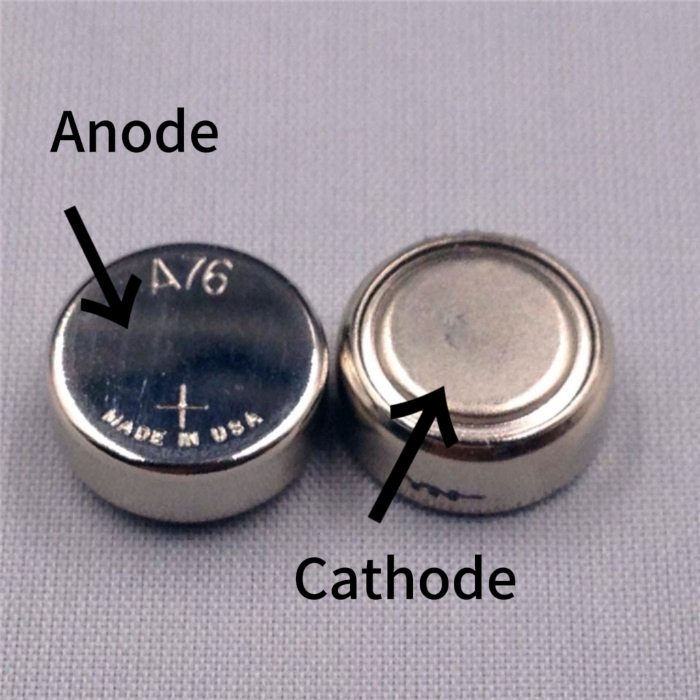
Step-by-Step: How to Safely Replace an A76 Battery
Follow these replacement steps to ensure a safe and error-free replacement process.
Step 1. Prepare the Device: Turn off the device's power. For medical devices or children's toys, remove them from their usage environment to ensure a safe working area.
Step 2. Record Information: Open the battery compartment. Before removing the old battery, note its model number and observe or photograph the correct installation orientation (note the "+" positive terminal direction).
Step 3. Select New Battery: Using the recorded original model, consult an equivalent replacement chart to confirm the replacement battery's size, voltage, and chemical system meet requirements.
Step 4. Remove Old Battery: Use a clean, dry non-metallic tool (e.g., plastic pry tool) to carefully extract the old battery. Avoid touching both terminals simultaneously to prevent short circuits or damage to compartment contacts.
Step 5. Installation and Testing: Perform contact cleaning by ensuring the battery compartment contacts are free of dust or corrosion. Insert the new battery according to the recorded correct orientation, typically aligning the "+" symbol with the "+" mark inside the compartment. Replace the compartment cover and test the device functionality.
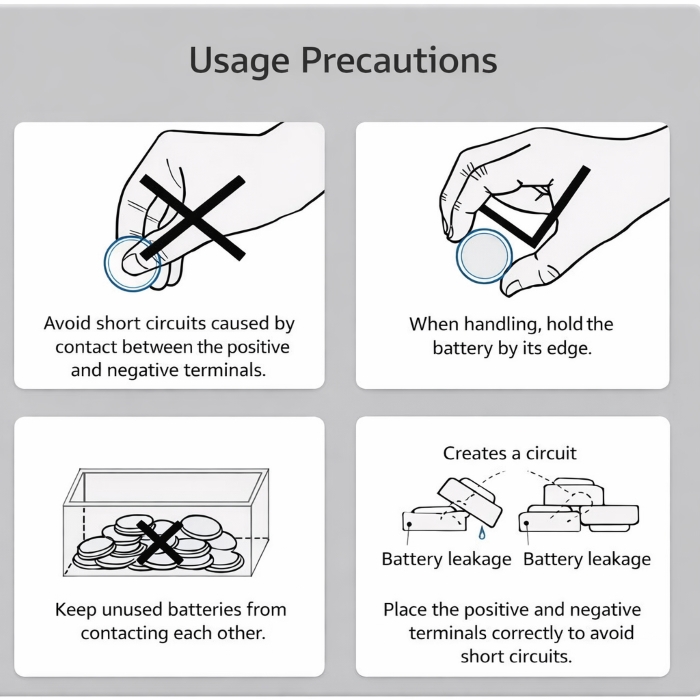
Handling, Storage, and Disposal
Safe handling, proper storage, and environmentally responsible disposal of A76 equivalent batteries are critical for safety and environmental protection.
1. Safe Handling
• Prevent short circuits: Store batteries separately. Do not mix with metal items like keys or coins to avoid contact between positive and negative terminals, causing short circuits and overheating.
• Preventing Ingestion: Button batteries pose extreme danger to young children. Store them where children cannot possibly reach them, and ensure device battery compartments have safety locks (e.g., screw-secured).
• Do Not Mix: Never combine batteries of different brands, chemical types, or states of charge.
2. Proper Storage
• Adhere to optimal storage conditions: Unused batteries should remain in their original packaging and be stored in a cool, dry place (for example, 15-25 °C), away from high heat (e.g., above 60 °C) and high humidity (e.g., above 70%), and direct sunlight.
• When storing batteries loose, ensure they are insulated from each other and avoid direct contact with metal containers.
3. Environmentally Responsible Disposal
• Do not dispose of used batteries with household waste.
• Deliver them to designated battery recycling points, commonly found at supermarkets, electronics stores, or community recycling stations (specific recycling channels vary by country and region), to ensure safe disposal and resource recovery.
From Datasheet to Sourcing: A76 Equivalents in Your BOM
When transitioning from design to production, engineers and procurement personnel must rely on this Battery Cross-Reference Guide to accurately convert generic identifiers like "A76" or "LR44" in schematics into specific brand part numbers available for procurement in the Bill of Materials (BOM). Adhering to clear parameter priorities—especially form‑fit‑function (FFF) compatibility (dimensional fit, installation adaptability, and functional performance matching)—ensures accurate selection, stable supply, and seamless cross‑reference between equivalent models.
The core process for selection and procurement is illustrated below :
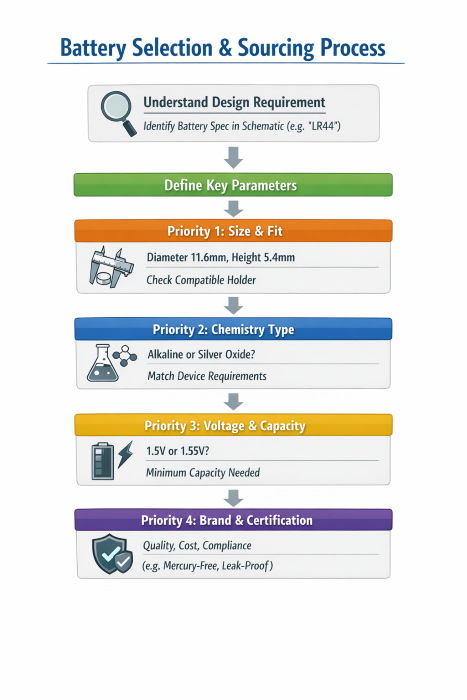
2. Execute supplier search: Utilize cross-reference tables to convert standard part numbers into specific part numbers for target brands, then proceed with quotation requests and procurement.
Example of Design-to-Material Mapping (Including Brand-Specific LR44/A76 Equivalents):
|
Schematic/Design File Identifier |
IEC/ANSI Standard Model |
Battery Chemistry |
Example Brand Part Number (Corresponding Alternative) |
|
BAT1: "A76" or "1.5 V Cell" |
LR44 |
Alkaline |
Energizer: A76; Panasonic: LR44; Rayovac LR44; Vinnic: L1154 |
|
BAT1: "Button Cell 1.55 V" |
SR44 |
Silver Oxide |
Renata: 357; Maxell: SR44SW; Vinnic: L1154 (Silver Oxide Variant) |
|
BAT1: "AG13" |
LR44 (Equivalent) |
Alkaline (brand names may vary; refer to the labeled chemical system) |
GP: AG13; Sony: LR44; Vinnic: L1154 |
|
BAT1: "LR44" or "Alkaline Button Battery" |
LR44 |
Alkaline
|
Panasonic: LR44; Energizer: A76; GP: AG13; Vinnic: L1154 (Alkaline Variant) |