LPDDR Memory Explained: Low-Power DDR vs DDR5 Guide
| Table of Contents |
In electronic device hardware design, the selection of memory solutions directly determines a product's power consumption, performance ceiling, and form factor. As the core memory technology for mobile and low-power scenarios, LPDDR has become standard in smartphones, ultra-thin laptops, automotive terminals, and edge AI devices. This article provides a comprehensive technical reference for hardware engineers, product managers, and procurement personnel—covering foundational concepts, generational evolution, core differences, practical Q&A, and selection/procurement—balancing technical depth with practical applicability.
What is LPDDR Memory?
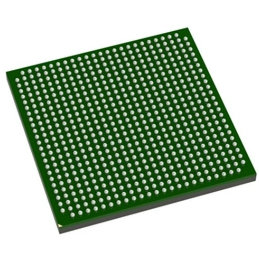
LPDDR is a DRAM variant specifically optimized for mobile applications. Its core advantage lies in balancing "high-performance data transmission" with "ultra-low power consumption control," making it a critical component for achieving long battery life and compact designs in mobile devices.
LPDDR Acronym and Basic Concept
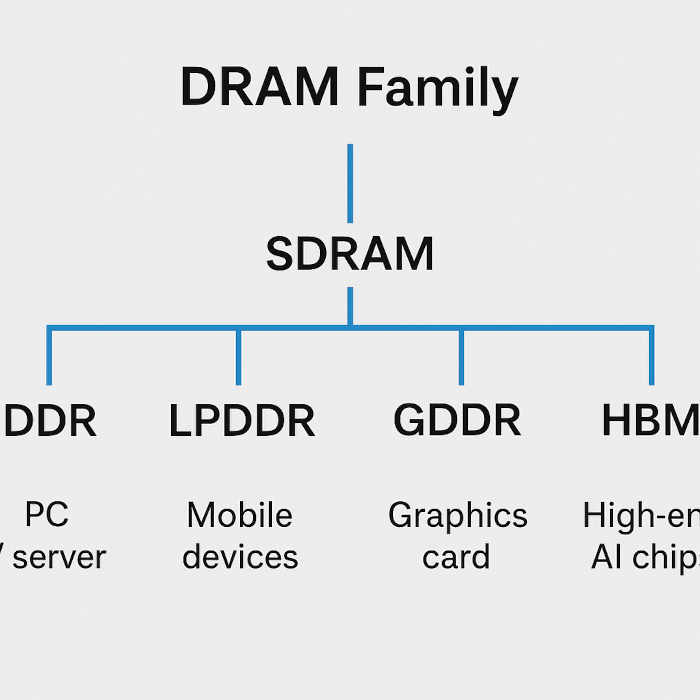
LPDDR stands for Low-Power Double Data Rate Synchronous DRAM, a specialized category within the DDR SDRAM family. It is specifically engineered to meet the core requirements of mobile devices for "low power consumption and compact size."
- Its core characteristics can be summarized in two points:
-
- Double Data Rate Technology: Data is transmitted on both the rising and falling edges of the clock signal, doubling the data throughput compared to SDRAM at the same frequency. This enables high-performance tasks such as multitasking, HD video playback, and edge AI inference.
- Deep Power Optimization: Through design enhancements like reduced operating voltage, simplified bus architecture, and enhanced deep sleep modes, power consumption is only 50%-70% of that of standard DDR of the same generation, significantly extending device battery life.
- Double Data Rate Technology: Data is transmitted on both the rising and falling edges of the clock signal, doubling the data throughput compared to SDRAM at the same frequency. This enables high-performance tasks such as multitasking, HD video playback, and edge AI inference.
- LPDDR's typical application scenarios span various mobile, low-power, and automotive applications, as detailed in the table below. For developers specifically interested in ultra-low-power embedded solutions beyond memory and looking toward a lower-power future, the MCX L series offers insights into how new MCU architectures are achieving sub-µA consumption for always-on battery devices.:
|
Device Type |
Core Requirements |
Common LPDDR Generations |
|
Smartphones / Tablets |
Long battery life, compact size, high bandwidth |
LPDDR5/LPDDR5X |
|
Ultra-Thin Laptops |
Low power consumption, ultra-slim design |
LPDDR4X/LPDDR5 |
|
Wearables |
Ultra-low power consumption, micro-package |
LPDDR4/LPDDR5 |
|
In-vehicle smart terminals |
Wide temperature range, high stability |
LPDDR5 (Automotive Grade) |
|
Edge AI Devices |
High Bandwidth, High Energy Efficiency Ratio |
LPDDR5X/LPDDR6 |
As a key complement to NAND Flash in storage subsystems, LPDDR enables high-speed data processing. At the same time, NAND Flash handles long-term data storage, forming a synergistic solution for electronic devices.
LPDDR Generations Overview (LPDDR1 to LPDDR6)
Since its introduction in 2006, LPDDR has undergone multiple generations of iteration, with core trends including "continuous bandwidth enhancement, gradual voltage reduction, and expanding feature sets." Key parameters for each generation are shown in the table below:
|
Generation |
Release Date |
Typical Data Rate |
Operating Voltage |
Core Improvements |
Typical Application Scenarios |
|
LPDDR1 |
2006 |
200–400 MT/s |
1.8V |
First implementation of the "Low Power DDR" architecture, supporting self-refresh |
Early feature phones, MP4 players |
|
LPDDR2 |
2009 |
800-1066 MT/s |
1.2V |
Added deep sleep mode, doubling bandwidth |
Smartphones (iPhone 4/5 series) |
|
LPDDR3 |
2012 |
1333-2133 MT/s |
1.2V |
Supports dual-channel, introduces a temperature compensation mechanism |
4G smartphones, entry-level tablets |
|
LPDDR4 |
2014 |
2133-3200 MT/s |
1.1V |
Bus width optimization (x16/x32), 30% lower power consumption |
Mid-to-high-end 4G smartphones, ultrabooks |
|
LPDDR4X |
2017 |
3733-4266 MT/s |
0.6V |
Features pseudo-open-drain circuitry, delivering a 20% improvement in energy efficiency |
High-end 4G/5G smartphones, mainstream ultrabooks |
|
LPDDR5 |
2019 |
4800-6400 MT/s |
1.1V |
Supports DVFS and Data-Copy mode |
5G flagship phones, edge AI devices, automotive systems |
|
LPDDR5X |
2022 |
7466-8533 MT/s |
1.1V |
30% bandwidth increase, supports multi-bank refresh, and advanced Bank Management |
High-end flagship smartphones, AI ultrabooks |
|
LPDDR5T |
2023 |
9333 MT/s |
1.1V |
Automotive-grade optimization, supporting -40°C to 125°C wide temperature range |
Smart Cockpit, Autonomous Driving Terminal |
|
LPDDR6 |
2024 |
12,000 MT/s |
1.0V |
New signal encoding, 25% improvement in energy efficiency |
Next-generation flagship devices, high-end AI terminals |
LPDDR vs “Mobile DDR” Naming
Historically, the industry commonly used "Mobile DDR (abbreviated as mDDR)" to refer to the first-generation LPDDR products. With the introduction of unified standards by JEDEC Solid State Technology Association, subsequent products were officially named LPDDR2, LPDDR3, and higher versions, gradually standardizing the naming convention.
Engineers maintaining legacy projects or selecting replacements must pay close attention. When encountering terms such as "Mobile DDR," "mDDR," or "LPDDR1" in datasheets or BOMs, verify the JEDEC standard generation, pin compatibility, and memory controller support to avoid selection errors caused by naming confusion.
Common naming aliases and their corresponding JEDEC standards are listed in the table below:
|
Common Aliases |
Corresponding JEDEC Standard |
Applicable Scenarios |
Considerations |
|
Mobile DDR |
LPDDR1 |
Early-generation low-performance mobile devices |
Not compatible with LPDDR2 and later generations due to different pin definitions |
|
mDDR |
LPDDR1 |
Industrial control, legacy consumer electronics |
The operating voltage must be confirmed to match the controller |
|
LPDDR2 |
LPDDR2 |
Early 4G smartphones, tablets |
Not pin-compatible with LPDDR1, with significant bandwidth improvement |
|
LPDDR3 and above |
Same-name standard |
Mid- to high-end mobile devices, automotive systems, and related systems. |
Complies with unified JEDEC specifications, with limited backward compatibility |
LPDDR vs DDR: Architectural, Power, and Performance
Although LPDDR and standard DDR both belong to the DRAM family, they are designed for different application scenarios and exhibit significant differences in bus architecture, packaging form, power consumption control, and performance. To fully appreciate these architectural choices, it is helpful to understand the difference between microprocessors and application processors, as LPDDR is specifically optimized to pair with the latter in integrated mobile systems.
Bus Architecture and Packaging: Why is LPDDR More "Mobile-Oriented"?
The core distinction between LPDDR and standard DDR lies primarily in their bus and packaging designs, which directly determine their respective application scenarios:
|
Comparison Dimensions |
LPDDR (Low Power DRAM) |
DDR (Standard Memory) |
|
Bus Width |
Typically x16/x32, supports narrow bus designs |
Typical x64, wide bus architecture |
|
Topology |
Primarily point-to-point |
Multi-channel shared bus |
|
Command/Address Encoding |
Optimized encoding methods to reduce signal complexity, with enhanced data strobe synchronization for stable transmission |
Traditional encoding prioritizing compatibility |
|
Package types |
BGA, MCP (Multi-Chip Package), PoP (Package-on-Package) |
DIMM Module (Desktop/Server), SODIMM (Notebook) |
|
Space Occupancy |
Minimal, supports SoC stacking integration
|
Significant, requires dedicated slot space
|
|
Signal integrity requirements |
Adapted for compact layouts, optimized for anti-interference design |
Relies on the motherboard routing space, with lower anti-interference requirements |
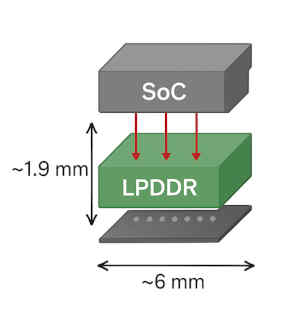
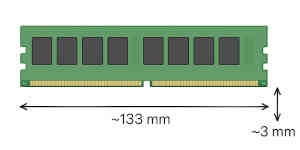
These design differences enable LPDDR to fit within the limited internal space of compact devices such as smartphones and tablets. At the same time, DDR is better suited to devices with lower memory bandwidth requirements, such as desktops and servers.
Power States and Low-Power Features
LPDDR's low-power advantage stems from multiple hardware designs and software optimizations, with core mechanisms including:
- Reduced operating voltage: Gradually decreased from 1.8V in LPDDR1 to 1.0V in LPDDR6, significantly lowering power consumption;
- Deep Power-Down Mode: Shuts down most circuits during idle periods, retaining only essential wake-up modules;
- Partial Array Self-Refresh: Self-refreshes only active data regions, minimizing wasted power consumption;
- Fine-grained clock/power gating: Dynamically turns off clocks and power to idle channels based on load, optimizing Memory Clock Operation for further power savings;
- Advanced optimizations (LPDDR5 and above): Supports DVFS (Dynamic Voltage and Frequency Scaling) and Data-Copy/Self-Refresh modes, enabling precise power control even in high-bandwidth scenarios.
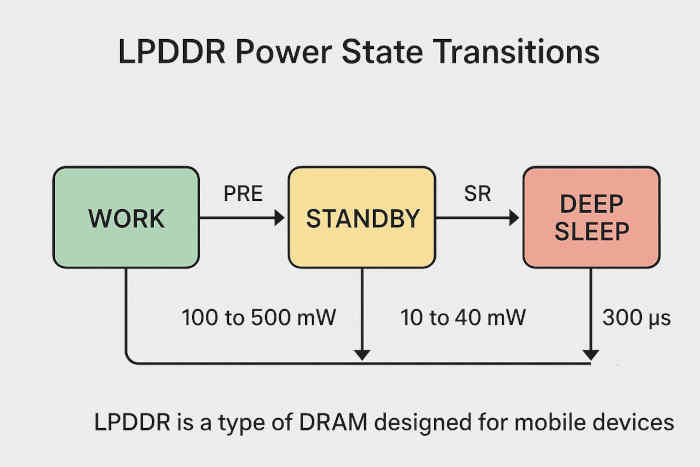
Actual test data show that under identical bandwidth requirements, LPDDR5's operating power consumption is only 40%-60% of DDR5's, while its standby power consumption is 10%-20% of DDR5's. This is the core reason mobile devices prioritize LPDDR.
Performance and Bandwidth: LPDDR4 vs DDR5 – How to Choose?
The performance difference between LPDDR and DDR cannot be judged simply by asking "which is better." It requires careful consideration across dimensions such as bandwidth, latency, and scalability:
|
Memory Type |
Typical Data Rate |
Single-Channel Bandwidth |
Latency Performance |
Scalability |
Suitable Scenarios |
|
LPDDR4X |
4266 MT/s |
34.1 GB/s |
Mid-to-High |
Poor (Soldered) |
Mid-to-high-end smartphones, ultrabooks |
|
LPDDR5 |
6400 MT/s |
51.2 GB/s |
Medium |
Poor (soldered) |
Flagship smartphones, edge AI devices |
|
LPDDR5X |
8533 MT/s |
68.3 GB/s |
Medium |
Poor (soldered) |
High-end flagship phones, AI ultrabooks |
|
DDR4 |
3200 MT/s |
25.6 GB/s |
Low |
Good (expandable) |
Desktop, entry-level servers |
|
DDR5 |
6400 MT/s |
51.2 GB/s |
Mid-to-low |
Good (scalable) |
High-end desktops, servers |
Selection Recommendations:
- Desktop/Workstation: Prioritize DDR5 for memory scalability and high-frequency overclocking, meeting demanding office and high-end gaming needs;
- Data Center Servers: Stick to DDR5 for massive capacity expansion, multi-channel bandwidth aggregation, and 24/7 stable operation requirements;
- Ultrabooks / Embedded Devices: Opt for LPDDR4X/LPDDR5 to achieve balanced performance within strict power budgets, balancing battery life and form factor thickness;
- Battery-Powered Devices: Mandatory LPDDR selection. Low-power characteristics are critical for extended battery life, and a soldered-in design reduces the risk of contact failure.
How LPDDR Affects Power Consumption and Battery Life?
In mobile devices, the memory subsystem is the second-largest power drain after the SoC. LPDDR delivers significant battery life improvements:
- Smartphone Scenario: Devices using LPDDR5 reduce memory power consumption by approximately 20%-30% compared to LPDDR4X when the screen is on, and by over 50% in standby mode, extending normal usage by 1-2 hours and significantly improving user experience.
- Ultrabook Scenario: Models with LPDDR5 offer 30%-40% longer battery life than comparable DDR5 devices, with more pronounced differences in light-load scenarios like mobile office work and video playback.
This disparity stems from LPDDR's deep optimization for mobile scenarios, which enables dynamic power-state adjustments based on device load. In contrast, DDR's power management tends toward a "one-size-fits-all" approach, struggling to adapt to the frequent changes inherent in mobile usage.
Practical Q&A: Gaming Performance and Soldered LPDDR
Is LPDDR More Suitable for Gaming and General Performance?
- Conclusion: DDR is preferred for high-end gaming scenarios, while LPDDR offers more balanced performance in mobile gaming scenarios.
Memory selection recommendations for different user scenarios:
|
User Type |
Core Requirement |
Recommended Memory Type |
Reason |
|
Hardcore Gamers |
High bandwidth, large capacity, overclockable |
DDR5 (Desktop), DDR5 SODIMM (Gaming Laptop) |
Supports high-frequency overclocking, expandable beyond 64GB, and delivers optimal performance with discrete graphics cards |
|
Mobile Office Users |
Long battery life, lightweight multitasking |
LPDDR4X/LPDDR5 |
Low-power design meets document editing and web browsing needs with significant battery life advantages. |
|
Integrated graphics gamers |
Balanced performance, low power consumption |
LPDDR5 (shared memory with integrated GPU) |
High bandwidth enhances integrated GPU performance and delivers superior power efficiency compared to DDR. |
|
Embedded / Industrial Users |
High stability, wide temperature range |
Automotive-grade LPDDR5/LPDDR5T |
Soldered design reduces failures; a broad temperature range supports operation in harsh environments. |
Note that with the introduction of LPDDR5X/LPDDR6, their bandwidth has reached or even surpassed that of DDR5. This enables smooth performance when running AAA games on devices like ultrabooks. However, constrained by power walls and thermal design limitations, sustained high-load performance still lags behind DDR platforms.
Must LPDDR be soldered onto the motherboard?
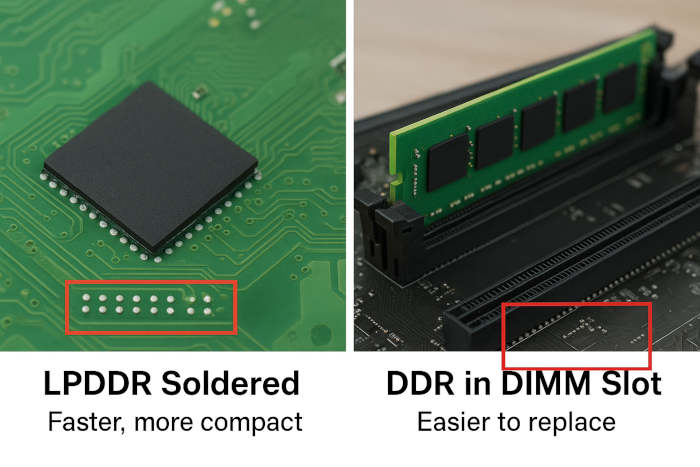
- Conclusion: In consumer electronics, LPDDR is almost always soldered in place; replaceable modules exist in industrial/development board scenarios.
- Key Explanation:
-
- Consumer devices (phones, tablets, ultrabooks): LPDDR is directly soldered onto the motherboard or SoC package in BGA or PoP form. Users and repair technicians cannot replace or upgrade it; capacity and generation must be finalized during the selection phase.
- Special scenarios (development boards, industrial modules): A few manufacturers offer pluggable LPDDR modules, but these require dedicated slots, controllers, and customized system initialization code and are not mainstream solutions.
- Selection Reminder: Confirm the product's memory configuration before procurement. If future capacity expansion is anticipated, avoid LPDDR platforms and prioritize devices supporting DDR slots.
- Consumer devices (phones, tablets, ultrabooks): LPDDR is directly soldered onto the motherboard or SoC package in BGA or PoP form. Users and repair technicians cannot replace or upgrade it; capacity and generation must be finalized during the selection phase.
Impact of LPDDR on On-Device AI and Edge Inference Performance
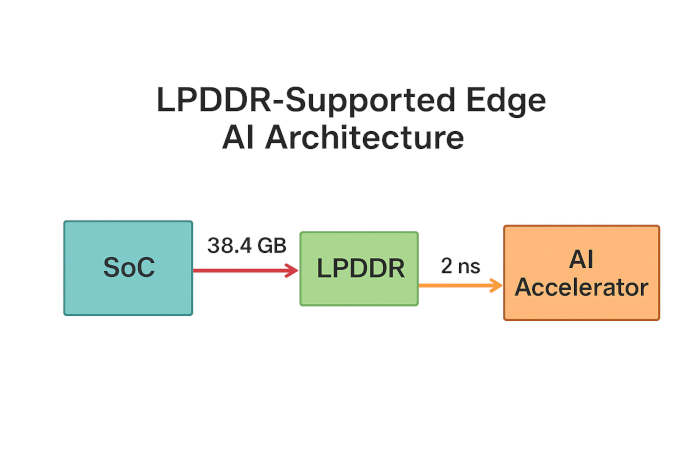
On-device AI demands extremely high memory bandwidth and energy efficiency. LPDDR5/5X has become standard in next-generation mobile SoCs due to:
- High Bandwidth Support: AI inference requires frequent access to extensive model parameters. LPDDR5 delivers a single-channel bandwidth of 51.2 GB/s, significantly reducing data access latency and accelerating inference speed.
- High Energy Efficiency: Battery-powered edge devices benefit from LPDDR's ability to deliver high bandwidth while consuming only half the energy per bit compared to DDR5, ensuring AI functions do not excessively drain battery life.
- Multi-task Adaptability: Supports concurrent execution of AI inference, high-definition video decoding, and other tasks with flexible bandwidth allocation, while compatibility with GDDR6 IP expands its application in graphics-intensive edge AI scenarios, preventing performance bottlenecks.
- Typical application scenarios include: mobile voice recognition, real-time image processing, lightweight LLM (Large Language Model) operation, autonomous driving perception algorithms in automotive terminals, and image recognition and data processing in edge devices.
LPDDR-Supported Edge AI Architectures:
From Specs to Purchasing: How to Choose and Source LPDDR
Critical Specification Parameters to Lock Down During Selection
Hardware engineers and procurement teams must prioritize the following parameters during selection to prevent design failures due to specification mismatches:
Capacity and Density: Determine single-chip capacity (Gb/GB) and total capacity requirements, noting unit conversion (1 GB = 8 Gb);
Channel and Bus Width: Select x16/x32 bus width based on SoC support and LPDDR4 IP compatibility, and confirm channel count (single-channel/dual-channel);
- Data Rate: Must be compatible with the SoC controller. For example, LPDDR5 rates must be selected within the 4800-6400 MT/s range.
- Operating Voltage: Confirm supply voltage (e.g., 1.1V for LPDDR5) to avoid mismatches with power management ICs;
- Operating Temperature: Select consumer-grade (0°C to 85°C) or automotive-grade (-40°C to 125°C) based on application requirements;
- Package Type: Select BGA/PoP/MCP based on motherboard design; verify package dimensions and pin definitions;
- JEDEC Compatibility: Must comply with JEDEC standards and integrate with Denali Memory Interface to ensure compatibility with SoC and controllers;
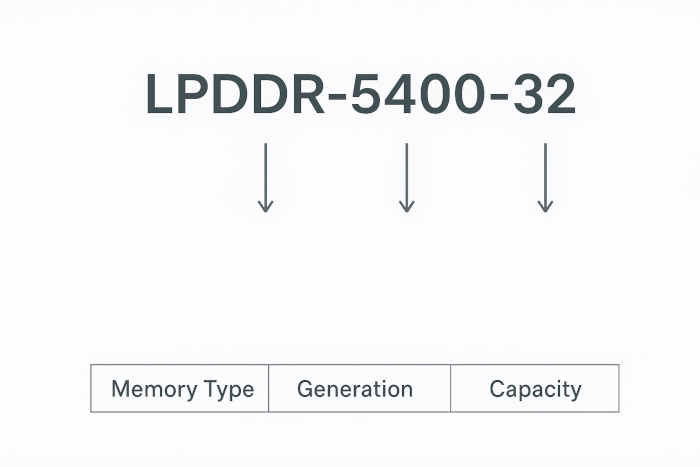
- Part Number Interpretation: Using Samsung K3LK3K30BM-AGCJ as an example, breakdown: K3LK3 (series identifier), K30B (capacity/speed), M (package type), AGCJ (version/temperature grade).
Example: "LPDDR-5400-32":
Compatibility and Lifecycle: EOL/PCN Risks and Replacement Strategies
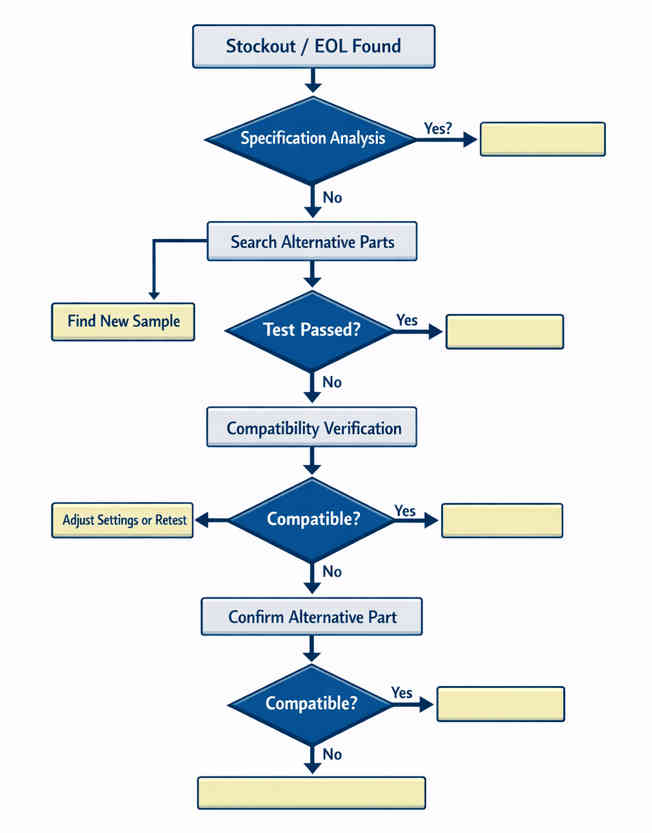
Rapid LPDDR generational shifts (average 3-4 years per generation) combined with frequent consumer electronics iterations create significant EOL (End-of-Life) and PCN (Product Change Notice) risks, particularly impacting long-lifecycle industrial/automotive projects.
Risk Mitigation Strategy:
- Confirm lifecycle in advance: Verify the product's EOL status with suppliers during selection, prioritizing models currently in "mass production" with no discontinuation plans;
- Establish Second-Source Suppliers: Select 2-3 brands offering compatible products with identical specifications to prevent project delays caused by a single supplier discontinuing production;
- Monitor PCN notifications: Establish a PCN alert mechanism with suppliers to receive advance notice of product changes and assess their impact on designs;
- Alternative Component Selection Principles: Prioritize "drop-in replacement" models, ensuring identical pin definitions and electrical parameters, and conduct rigorous Memory Test to avoid motherboard redesigns.
LPDDR Replacement Selection Flowchart:
Using Unikeyic Inventory to Solve Shortages and Replacements
As a professional electronic component distributor, Unikeyic Electronics leverages extensive inventory and technical support to provide LPDDR selection and out-of-stock solutions:
- Stock Availability: Comprehensive coverage of all generations from LPDDR4 to LPDDR6, including consumer-grade and automotive-grade models, with ample inventory supporting same-day shipping;
- Alternative Component Matching: Upon receiving model numbers or BOM lists, our FAE team leverages the Cadence VIP portfolio for compatibility simulation and provides drop-in or controller-level compatible alternatives within 24 hours, ensuring consistent performance.
- Technical Support: Detailed datasheets, compatibility test reports, and Full IP Integration Solutions are provided to assist customers in completing selection verification.
- Long-Term Supply Assurance: For industrial/automotive projects, we offer long-term supply agreements with inventory lock-in to mitigate EOL risks;
- Streamlined procurement: Supports model search, BOM upload, online quoting, and other features to simplify procurement and shorten delivery cycles.
- Case Study: An automotive terminal manufacturer faced the discontinuation of LPDDR5 products from their original supplier. Through Unikeyic's replacement component service, they rapidly identified a compatible model. Without requiring a motherboard redesign, sample testing and bulk procurement were completed within just 2 weeks, preventing project delays.
Conclusion
As a core low-power memory technology, LPDDR has become the preferred solution for mobile devices, edge AI, and automotive electronics. Its "high bandwidth, low power consumption, and compact size" characteristics perfectly align with modern electronic device design requirements. During selection, performance, power consumption, compatibility, and lifecycle must be comprehensively evaluated. In the procurement phase, choosing distributors with ample inventory and robust technical support mitigates supply chain risks.
Unikeyic Electronics delivers "one-stop" services for engineers and procurement professionals through its comprehensive LPDDR portfolio, expert selection support, and shortage solutions, accelerating product realization. Whether designing next-generation smartphones, ultrabooks, automotive terminals, or edge AI devices, you'll find the ideal LPDDR memory solution.
Frequently Asked Questions
What are the core differences between LPDDR and DDR?
The core differences lie in power consumption, packaging, and scalability: LPDDR features low power consumption, compact packaging, and is typically soldered in place, making it suitable for mobile devices; DDR has higher power consumption, supports capacity expansion, and uses a slot form factor, making it ideal for desktops/servers.
Which is better for thin-and-light laptops: LPDDR4 or DDR5?
Prioritize LPDDR4X or LPDDR5. While DDR5 offers comparable bandwidth, LPDDR's low power consumption significantly extends battery life and better accommodates ultra-thin chassis designs.
What are the special requirements for automotive-grade LPDDR?
It must support a wide temperature range of -40°C to 125°C, higher interference resistance, and enhanced stability. Typically, LPDDR5T or automotive-certified LPDDR5 models are selected.
How could we determine LPDDR model compatibility?
Focus on verifying JEDEC generation, data rate, bus width, operating voltage, package type, and DRAM controller support. Prioritize models labeled as "compatible replacements" by suppliers.
What should I do if LPDDR is out of stock?
Contact Unikeyic to upload your BOM or model information. Our FAE team will quickly identify compatible alternatives to make sure your project remains unaffected.