Microprocessor vs Integrated Circuit: Key Differences Explained
| Table of Contents |
Core Conclusion: A microprocessor is a subset of integrated circuits, essentially a highly complex programmable computing core. Integrated circuits, however, are a broad concept encompassing specialized and general-purpose semiconductor chips. The core differences between the two lie in their functional positioning, complexity, and system roles. Below is a detailed breakdown based on practical engineering scenarios.
Basic Concepts: What Is an Integrated Circuit? What Is a Microprocessor?
What Is an Integrated Circuit (IC)?
Simply put, an integrated circuit is a device that integrates millions or even billions of MOSFETs (Metal-Oxide-Semiconductor Field-Effect Transistors), resistors, capacitors, and other electronic components onto a single semiconductor
Common types include:
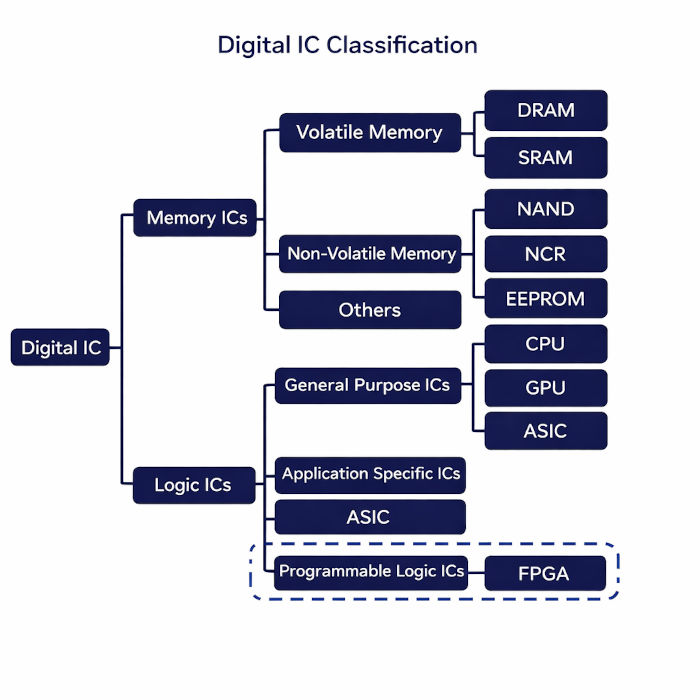
- Analog ICs: Primarily process continuous signals, such as operational amplifiers, power management ICs (PMICs), and audio amplifiers. The Low Dropout Regulator (LDO) in our power module belongs to this category.
- Digital ICs: Process discrete digital signals, including logic gates, memory (RAM, ROM), and interface chips (USB, UART controllers)—a category where digital ICs are widely used in consumer electronics and industrial control due to their stable signal processing capabilities;
- Mixed-signal ICs: Integrate both analog and digital functions, such as sensor chips with ADCs/DACs and RF transceiver chips;
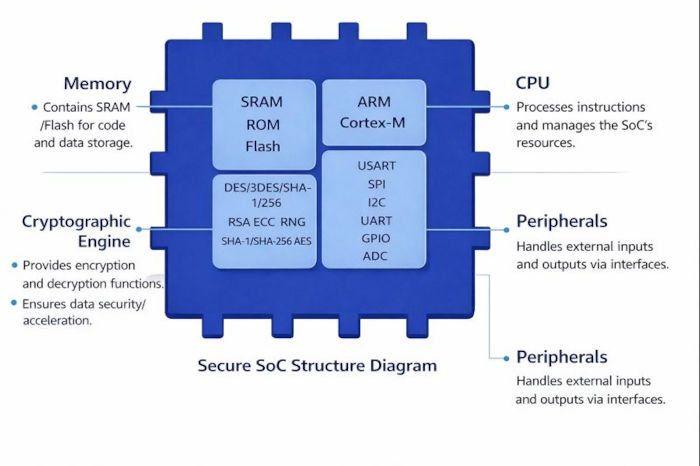
- Application-Specific Integrated Circuits (ASICs)/System-on-Chip (SoCs): Custom-designed for specific applications. For example, the smartphone's application processor SoC integrates multiple modules, such as the CPU, GPU, and ISP.
It's important to clarify: IC is a broad umbrella term encompassing all semiconductor integrated circuits. Microprocessors represent just one specific type within this category.
What Is a Microprocessor?
The core of a microprocessor is the fully integrated central processing unit (CPU) on a single chip. Its primary role is to execute arithmetic and logic operations and control program flow, serving as the "brain" of an electronic system.
Its internal structure primarily comprises the following components, familiar to hardware engineers:
- Arithmetic Logic Unit (ALU): Handles operations like addition, subtraction, multiplication, division, AND, OR, and NOT.
- Control Unit (CU): Decodes instructions and coordinates module operations, such as directing data from memory into registers.
- Register Set: Temporarily stores data and instructions, operating significantly faster than main memory;
- Internal Bus: Connects all modules, transmitting data and control signals;
- Higher-end systems also feature Cache, which further accelerates data access, reducing reliance on external memory.
Typical applications include devices requiring complex computations, such as computer CPUs (Intel i7, AMD Ryzen), high-performance embedded processors in embedded systems and industrial control systems, ADAS systems use high-end microprocessors for image processing, smart home devices use low-power MCUs (a type of microprocessor), and server-grade multi-core processors (e.g., Intel Xeon, AMD EPYC)—all of which are high-performance microprocessors.
To illustrate: The microprocessor is the brain of electronic systems, responsible for decision-making and issuing commands; other ICs function as the senses and muscles.
Clarifying the Relationship: Is a Microprocessor an Integrated Circuit?
Is a Microprocessor an Integrated Circuit?
Short Answer: Yes. A microprocessor itself is a highly complex integrated circuit.
In engineering terms, this means: All microprocessors are integrated circuits, but not all integrated circuits are microprocessors.
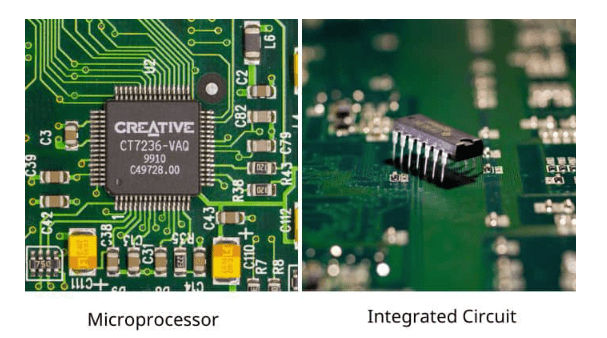
Consider these common examples:
- Operational amplifier ICs (e.g., LM324): Capable only of signal amplification, unable to execute programs; not microprocessors.
- Logic gate ICs (e.g., 74HC00 series): They only implement AND/NOT logic functions and lack computational or program control capabilities, so they are not microprocessors;
- Memory ICs (e.g., DDR4 memory chips): Responsible solely for data storage, incapable of actively executing instructions, and therefore not microprocessors.
Can an IC work without a microprocessor?
Yes, many integrated circuits (ICs) can work independently without a microprocessor.
For example, basic analog ICs like operational amplifiers, power management ICs, and digital logic ICs (such as AND/OR gates) perform specific, fixed functions through their hardware design, requiring no microprocessor to control or coordinate their operations.
Why Are Microprocessors Considered a Specific Type of Integrated Circuit?
- Functionally, the core of a microprocessor is "programmable general-purpose computation." It can interpret and execute a series of instructions to process various data. In contrast, most standard ICs have fixed functions—for example, a voltage regulator IC only stabilizes output voltage, offering a single, non-programmable function.
- From a structural perspective, microprocessors are highly integrated products that combine massive numbers of logic gates, arithmetic units, and control logic. For instance, a modern CPU may contain billions, or even tens of billions, of transistors, whereas a typical logic IC might have only tens to hundreds of transistors. Their integration levels and complexity are fundamentally on different scales.
- In terms of system roles, within actual circuit designs, the microprocessor acts as the "master controller," coordinating the operation of all peripheral ICs such as memory, sensors, and interfaces. Other ICs function as "specialized modules," capable only of performing specific, narrowly defined tasks. For example, a PMIC handles power management, while a USB IC manages data transmission.
What Is the Difference Between a Microprocessor and an Integrated Circuit?
What distinguishes microprocessors from integrated circuits?
Core differences lie in three dimensions: Scope—microprocessors are a subset of ICs, encompassing all integrated circuits; Functional Positioning—microprocessors are programmable computing cores, whereas ICs include various fixed-function or specialized devices; System Role—microprocessors serve as core control units, whereas most ICs function as peripheral modules. The following comparison table outlines key characteristics for quick reference.
Microprocessor vs Integrated Circuit: Tabular Comparison
|
Comparison Dimension |
Microprocessor |
Integrated Circuit (IC) |
|
Definition |
A single-chip device integrating CPU functionality, capable of executing programs and processing data |
A general term for multiple components integrated onto a semiconductor chip to achieve specific electronic functions |
|
Core Functions |
Arithmetic logic operations, instruction decoding and execution, program flow control |
Signal amplification, voltage regulation, logic operations, data storage (e.g., SRAM/DRAM), signal conditioning, and interface conversion, etc. (diverse and fixed functions) |
|
Internal Structure |
Arithmetic Logic Unit (ALU), Control Unit, Register Set, Internal Buses, Cache (complex) |
Simple logic gates, transistor arrays, resistors, capacitors, etc. (structure determined by function, often relatively simple) |
|
Typical Examples |
Intel Core i9, ARM Cortex-A53, AMD Ryzen |
TI LM324 (Operational Amplifier), Nexperia 74HC00 (NAND Gate), DDR4 memory chip, LM1117 (LDO) |
|
Design Complexity |
Extremely high, involving multiple design aspects such as high-speed signals, EMI, power management, and boot sequences |
Varies significantly: Simple ICs (e.g., logic gates) are straightforward to design, while complex ICs (e.g., SoCs) present great difficulty. However, general-purpose ICs have fewer design constraints than microprocessors. |
|
Power Consumption and Clock Frequency |
High clock frequencies (GHz range), relatively high TDP, and requiring complex power management |
Clock frequency varies by function, typically low-frequency (kHz-MHz range), with generally low power consumption. |
|
External Dependencies |
Requires external memory (RAM/ROM), power ICs, and peripherals to function |
Most can operate independently, requiring only a power supply and the necessary external matching circuits |
To summarize: IC is a broad concept encompassing all integrated circuits, from simple logic gates to complex SoCs; microprocessors represent the most sophisticated category of ICs, with key advantages of programmability and general-purpose computing capabilities. They function as central controllers that require external support circuits.
Is a Microprocessor Bigger Than Other Integrated Circuits?
This "larger" nature must be considered from two perspectives and cannot be generalized.
- In terms of physical packaging/chip size, not necessarily. Some high-pin-count FPGAs or power ICs may have larger package dimensions than typical microprocessors. For example, industrial-grade FPGAs in BGA packages can exceed 30 mm × 30 mm, while some embedded microprocessors in QFP packages may measure only 10 mm × 10 mm. For designs requiring even higher integration in a smaller footprint, engineers might also consider utilizing a SIP package IC solution.
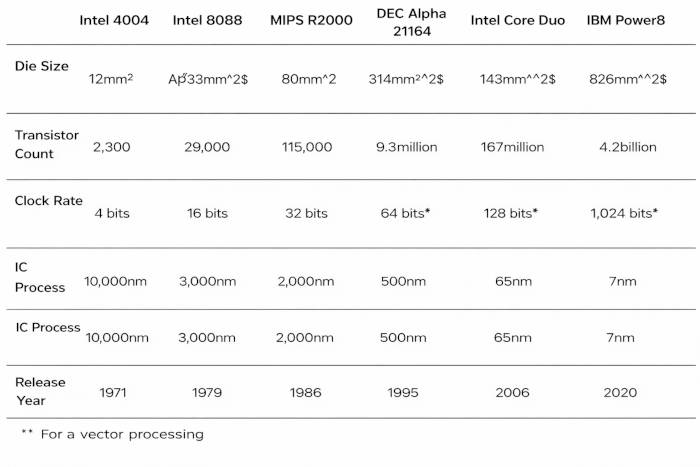
- In terms of transistor count/logic complexity, microprocessors are typically "larger."Microprocessors are part of Very Large Scale Integration (VLSI), with transistor counts in the hundreds of millions or even billions—for example, the Intel Core i9 processor has tens of billions of transistors. In contrast, typical logic ICs contain only tens to hundreds of transistors. Even more complex operational amplifier ICs typically have only thousands of transistors, placing them on an entirely different scale from microprocessors.
Selection Tip: When selecting components, prioritize processing capability over physical size. For simple logic, a 74HC series IC suffices; for complex calculation, choose a Microprocessor (MCU/MPU). Check Unikeyic's inventory for [STM32 series] or [NXP i.MX] processors for your next design.
This is the true determinant of a device's functionality and performance.
How Does the Complexity and Functionality of Microprocessors Compare to Simpler Integrated Circuits?
First, regarding complexity, the primary differences lie in three aspects:
- Number of transistors: Microprocessors contain hundreds of millions to billions, while simple ICs contain tens to thousands—a difference of several orders of magnitude.
- Internal Modules: Microprocessors integrate complex modules like ALUs, control units, registers, caches, and multiple interface controllers, while simple ICs typically feature only single-function modules;
- Interface diversity: Microprocessors support multiple high-speed/low-speed interfaces, such as USB, PCIe, DDR, UART, and SPI, while simple ICs generally have only 1-2 dedicated interfaces.
Functionality: The core difference lies in "programmable versatility" versus "fixed specialization":
- Microprocessors: By executing different programs, they perform diverse functions like data processing, logic control, and signal analysis, while enabling multitasking and offering exceptional flexibility.
- Simple ICs: Fixed functionality—e.g., the 74HC00 performs only NAND operations, while the LM1117 solely regulates voltage. Changing the function requires replacing the entire device.
This also results in vastly different design complexities: Microprocessor design requires addressing issues like high-speed signal integrity, electromagnetic compatibility (EMI), dynamic power management, and startup timing synchronization. Simple IC design, however, typically functions correctly with proper power decoupling and basic signal matching.
Evolution and System Role: How ICs Evolved into Microprocessors
How Did Integrated Circuits Evolve into Microprocessors?
The core of this evolution is "continuously increasing integration" of transistor circuits, aimed at reducing costs, shrinking size, and enhancing performance and reliability. From an engineering perspective, this process can be broadly divided into four stages:
- Discrete Component Era: Early electronic devices used individual transistors, resistors, and capacitors to build circuits. These were bulky, power-hungry, and unreliable—think early radios.
- Small-Scale/Medium-Scale Integration (SSI/MSI): Several to dozens of logic gates were integrated onto a single chip, such as the 74 series logic ICs. This simplified circuit design, but complex functions still required multiple chips.
- Large-Scale Integration (LSI): Capable of integrating thousands to tens of thousands of transistors, this era saw the emergence of early CPUs. However, these were board-level implementations. For instance, the first computer, ENIAC, used tens of thousands of vacuum tubes. Later, CPUs were realized using transistors and LSI chips, significantly reducing size but still requiring multiple chips.
- Very Large Scale Integration (VLSI): This marked the pivotal birth of microprocessors, enabling the integration of all CPU functions (ALU, control unit, registers, etc.) onto a single chip. The Intel 4004, introduced in 1971, became the world's first microprocessor. Subsequent iterations progressed from 4-bit, 8-bit, 16-bit, 32-bit, to 64-bit architectures, with ever-increasing transistor counts and improved performance.
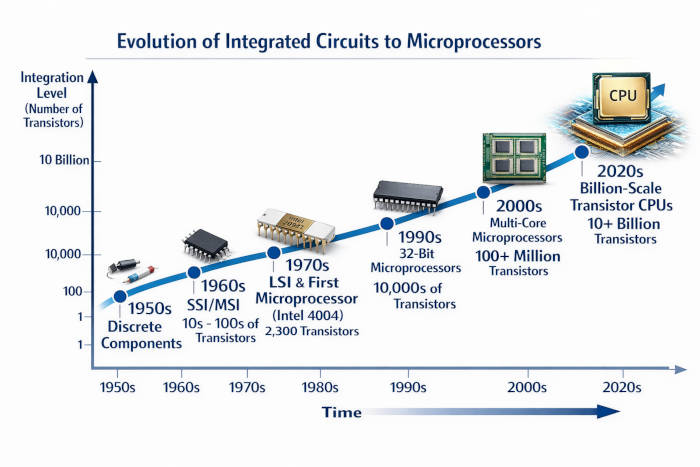
Simply put, this increase in integration transformed the "board-level CPU" into a "single-chip microprocessor," laying the foundation for the miniaturization and intelligence of modern electronic devices.
What Role Do Microprocessors Play in Modern Computing Devices Compared to Other Integrated Circuits?
From a system architecture perspective, the microprocessor serves as the "central controller," while other ICs act as "supporting components." Only through their collaboration can a complete system function. Their specific roles are clearly defined:
- Microprocessor: Receives and interprets instructions, processes sensor data, controls peripheral actions, and manages overall system operation—like a computer's CPU running the operating system and applications.
- Other ICs: Memory ICs store data and programs; PMICs ensure a stable power supply; sensor ICs collect data such as temperature and pressure; interface ICs handle data transmission; driver ICs control actuators, such as motors and LEDs.
Here are a few common engineering scenarios:
- PC/Server: CPU (microprocessor) + motherboard chipset (IC) + memory (IC) + graphics card (including GPU, a specialized microprocessor) + power supply IC, working together to enable data processing and graphical display;
- Embedded systems: For instance, industrial controllers use ARM Cortex-M series microprocessors alongside ADC chips (for analog signal acquisition), DAC chips (for analog signal output), and relay driver ICs (for external device control) to achieve precise industrial field control.
- Consumer Electronics: Application processors (microprocessors) in smartphones integrate CPUs, GPUs, ISPs, etc., working with RF ICs (signal transmission/reception), camera sensor ICs, and battery management ICs to enable functions like calling, photography, and internet access.
Extended Comparison: The Relationship Between Microcontrollers, Microchips, and ICs
What Is the Difference Between an Integrated Circuit and a Microcontroller?
First, define a microcontroller (MCU): a device that fully integrates a microprocessor core, Flash/RAM, timers, ADC/DAC, UART/SPI, and other I/O peripherals onto a single chip—essentially a "miniature integrated system."
In terms of classification, microcontrollers are a type of integrated circuit—specifically, a specialized IC containing a microprocessor core. The core differences from general-purpose microprocessors and standard ICs can be summarized as follows:
- Microcontroller vs. General-Purpose Microprocessor: MCUs integrate memory and peripherals into a single chip; general-purpose microprocessors require external memory and peripherals to function, as in a computer CPU.
- Microcontroller vs. Standard IC: MCUs are programmable, multifunctional system-level devices, while standard ICs are fixed-function single-purpose components. For example, an MCU can simultaneously handle data processing, timer control, and ADC acquisition, whereas an op-amp IC only performs signal amplification.
Typical MCU applications involve compact, low-power embedded scenarios like small appliances (rice cookers, washing machines), IoT devices (smart wristbands, sensor nodes), and automotive control units (window/light controls)—many of which integrate Digital Signal Processor (DSP) cores from manufacturers like Texas Instruments, where the Digital Signal Processor enhances real-time data processing capabilities.
What Is the Difference Between an IC and a Microchip?
In engineering practice, these terms are often used interchangeably. The key distinction lies between formal usage and colloquial usage.
Strictly speaking, IC (integrated circuit) is the formal term for all integrated circuits, representing the standardized engineering term. Microchip, on the other hand, is a colloquial term often used as a synonym for IC in many contexts. For example, saying "this product uses many microchips" essentially means it uses many ICs.
However, note a special case: sometimes "microchip" explicitly refers to "complex ICs with CPUs," such as microprocessors or microcontrollers. Simple logic ICs or op-amp ICs are called "ICs," not "microchips."
Therefore, when drafting technical documentation, creating BOMs, or communicating with suppliers, it's best to use "IC" followed by the specific model number. Examples include: "IC: LM324" or "MCU: STM32F103." This approach ensures accuracy and avoids ambiguity. For instance:
- Correct usage: "This project utilizes the STM32F103 microcontroller (MCU) and the LM324 operational amplifier IC."
- Ambiguous usage: "This project uses two microchips: the STM32F103 and the LM324," which may lead to a misunderstanding that both are complex chips.
Engineering Practice: Design, Selection, and Procurement Perspectives
Design Considerations: Using Microprocessors vs Other Integrated Circuits
From a hardware design perspective, the focus differs significantly between microprocessor and standard-IC designs. Here are several core design points summarized for practical application:
First, design considerations for microprocessors:
- High-Speed Layout and Routing: Microprocessors operate at high clock frequencies. Memory interfaces (e.g., DDR) and high-speed peripheral interfaces (e.g., PCIe) require strict control of impedance matching, trace length, and timing to prevent signal integrity issues.
- Power Integrity: Microprocessor cores, I/O, and Cache may require different voltage supplies. Ensure proper power distribution and strategically place decoupling capacitors to prevent voltage fluctuations from affecting operational stability.
- Reset and Startup: Design reliable reset circuits and monitor startup sequencing to ensure memory and peripherals are ready before microprocessor activation, preventing startup failures.
- EMI Control: High-speed signals readily generate electromagnetic interference. Implement robust grounding and shielding to prevent interference with other devices.
Now, design considerations for standard ICs:
- Power Decoupling: This is critical. Whether for op-amps or logic ICs, place 0.1 μF decoupling capacitors near the power pins to minimize power noise.
- Signal Matching: Adjust the signal line length and impedance to the IC's operating frequency. Low-frequency ICs (e.g., UART interfaces) typically require no special matching, while high-frequency ICs (e.g., RF ICs) demand strict matching.
- Package and Thermal Management: For power ICs (e.g., LDOs, driver ICs), prioritize package thermal capabilities to prevent overheating and damage from excessive power dissipation.
The comparison between microprocessors and simpler integrated circuits (ICs) in terms of complexity and functionality revolves around their core design purposes, internal structures, and application adaptability, with distinct differences across key dimensions:
1. Internal Structural Complexity
- Microprocessors: Boast highly intricate internal architectures engineered for general-purpose computing. They integrate multiple functional modules, including a central processing unit (CPU) with arithmetic logic units (ALUs), control units, and register sets, cache memory (L1/L2/L3) for data/instructions temporary storage, and a variety of high-speed peripheral controllers (e.g., PCIe, USB, DDR). Advanced microprocessors may adopt multi-core designs, out-of-order execution, and speculative execution technologies to enhance computing efficiency. With transistor counts ranging from millions to billions (e.g., x86 CPUs for servers or ARM Cortex-A series), their structural complexity enables complex instruction-set execution and multi-task scheduling.
- Simpler Integrated Circuits: Feature streamlined, single-purpose internal structures. These include analog ICs (e.g., op-amps, voltage regulators) and basic digital ICs (e.g., logic gates, flip-flops), which typically consist of hundreds to thousands of transistors. Their design is optimized for a specific function. For example, an LDO (Low-Dropout Regulator) IC only includes circuits for voltage stabilization and ripple suppression, with no redundant computing or control modules, resulting in a straightforward structural layout.
2. Functional Versatility and Programmability
- Microprocessors: Offer strong programmability and multi-functional adaptability. They execute instructions stored in external memory, enabling dynamic adjustment of functions through software updates without modifying hardware. A single microprocessor can handle diverse tasks such as data processing, logic control, human-machine interaction, and network communication. For instance, a smartphone CPU simultaneously manages app operation, camera image processing, and wireless signal transmission. This versatility makes them suitable for scenarios that require frequent functional iterations or the integration of complex tasks.
- Simpler Integrated Circuits: Provide fixed, single-function capabilities. Their functionality is hardwired during manufacturing, meaning they can only perform pre-designed, specific tasks. For example, an op-amp amplifies analog signals, a logic AND gate outputs a high level only when all inputs are high, and an ADC (Analog-to-Digital Converter) converts analog signals to digital data. They lack programmability and cannot be repurposed for other tasks—for example, a voltage comparator IC cannot be used for signal amplification.
3. Development and Design Complexity
- Microprocessors: Require system-level, multi-disciplinary development. Hardware design involves addressing high-speed signal integrity (e.g., impedance matching, timing closure for DDR interfaces), power integrity (e.g., multi-voltage domain management, decoupling capacitor layout), and EMI (Electromagnetic Interference) suppression. Software development is equally critical, including firmware programming, operating system porting, and application software design, all of which require complex debugging and optimization to leverage the microprocessor’s performance fully.
- Simpler Integrated Circuits: Involve straightforward development and design processes. Hardware design primarily focuses on basic parameter matching (e.g., selecting an op-amp with appropriate bandwidth and slew rate) and basic circuit configuration (e.g., placing decoupling capacitors near power pins for logic ICs). No software development is required—engineers only need to select ICs whose electrical parameters (e.g., output voltage, operating temperature range) match the application requirements, significantly reducing design cycles and technical thresholds.
4. Scalability and Expansion Potential
- Microprocessors: Support strong scalability through peripheral expansion and software upgrades. They can connect to various external components (e.g., memory, sensors, communication modules) via high-speed interfaces, enabling system function expansion. For example, an industrial control microprocessor can add Ethernet modules for remote monitoring or ADC modules for multi-channel data acquisition. Additionally, software optimization (e.g., algorithm improvement, multi-threaded programming) can further enhance performance without changing the hardware platform.
- Simpler Integrated Circuits: Have limited scalability. Hardware parameters fix their functionality and performance, and expansion requires modifying the circuit design (e.g., replacing an op-amp with a higher-bandwidth part to improve signal amplification) or adding additional ICs. For example, a basic logic-gate IC cannot be scaled to perform complex logic operations without combining multiple ICs, resulting in poor scalability compared to microprocessors.
Regarding component selection decisions, here's a simple guideline:
|
Application Scenario |
Recommended Solution |
Reasoning |
|
Requires complex logic control, multitasking, and programmability |
Microprocessor (complex scenarios) or MCU (simple scenarios) |
High flexibility, capable of software-based functionality modification to adapt to diverse requirements |
|
Requires only a single fixed function (e.g., amplification, voltage regulation, logic operations) |
Standard Application-Specific ICs |
Low cost, simple design, high reliability, no complex software development required |
|
Compact size, low power consumption, low-cost embedded applications |
MCU |
Single-chip integrated systems simplify circuit design, reduce BOM costs, and minimize PCB footprint. |
|
High-performance computing, big data processing (e.g., servers, PCs) |
High-end microprocessors (CPU) + specialized accelerator ICs |
Microprocessors deliver powerful computing capabilities, while specialized ICs enhance performance in specific scenarios (e.g., GPUs boost graphics processing capabilities) |
From Schematic to BOM: Sourcing Microprocessors and Integrated Circuits via Unikeyic
We engineers know that the most critical steps from completing schematic design to procuring components are "selecting the right parts, securing delivery, and ensuring authenticity." Here's a hands-on workflow for procurement via Unikeyic—proven efficient:
- Step 1: Organize Component Specifications. Extract key information from the schematic, such as: - Microprocessor model, core architecture, package type (e.g., QFP-64, BGA-144), supply voltage, operating temperature range - Peripheral IC type (e.g., LDO, ADC) and critical parameters (e.g., LDO output voltage 3.3V, ADC resolution 12-bit). Compile this into a comprehensive list.
- Step 2: Parameter Search and Model Matching. Log in to the Unikeyic website and use the parameter filter function. Search for terms like "ARM Cortex-M4 microprocessor" or "3.3V LDO IC," or directly input the model number from the schematic to quickly find the corresponding part number.
- Step 3: Confirm Substitution Strategy and Procurement. For critical components (e.g., microprocessors), verify datasheets to ensure full compatibility in packaging, pin definitions, and functional parameters when using alternatives. Standard IC substitutes can generally be selected directly. Unikeyic maintains substantial in-stock inventory, enabling same-day shipping for most components—ideal for project prototyping and small-batch procurement. For bulk purchases, competitive pricing is offered alongside guaranteed genuine products with batch traceability. This reliability makes it a trusted choice for demanding applications like industrial, automotive, and medical sectors.
Here's a selection/quotation checklist for your reference during procurement:
- Device Type: Microprocessor/MCU/Op-amp/LDO, etc.
- Core Parameters: Model, Package, Supply Voltage, Operating Temperature, Key Functional Parameters;
- Procurement Requirements: Quantity, lead time, acceptance of alternative components;
- Application Scenario: Industrial/Automotive/Consumer Electronics; any special reliability requirements (e.g., RoHS, UL certification).