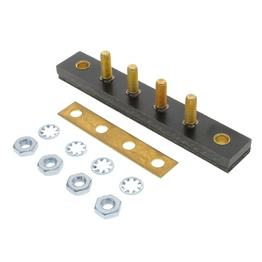
Barrier terminal blocks place insulating walls between adjacent connection positions. Their screw hardware, row arrangement and rear terminal style determine how wires connect to a board, panel or other wiring assembly.
Separated connection positions
The raised walls of a barrier block separate neighboring terminal positions around the wiring area. Screws and conductive terminal elements form the connection points, while the insulating body maintains the intended layout. The barrier structure is distinct from an environmental enclosure; any cover or sealing feature belongs to the specific product.
Single-row and double-row layouts
The row arrangement determines how terminal positions occupy the mounting surface. Centerline spacing and position count describe different dimensions of the block rather than its current rating alone.
Dual-barrier and tri-barrier forms
Different wall arrangements surround the connection area. Their screw hardware and terminal options belong to the selected barrier-strip family.
Tiered and pluggable forms
Bi-level constructions place wiring on separate physical levels. Some families add a removable mating interface, while others remain fixed assemblies.
Behind the wire connection
The rear connection can be as important as the visible screw row. Documented barrier-strip families include PCB pins, solder turrets, wire-wrap and quick-connect terminal styles. PCB and panel-mounted versions therefore need different mounting and termination descriptions even when their upper wiring faces look similar.
Clamp-screw and binding-head arrangements serve different termination hardware. These components appear in machine controls, power supplies and test equipment, with conductor size and electrical limits defined by the individual block rather than by the barrier shape.
Subscribe for promotions, market news, and platform updates.
I agree to receive marketing emails about promotions, market news, and platform updates. I understand that I can withdraw my consent at any time. Please review our Privacy Policy.